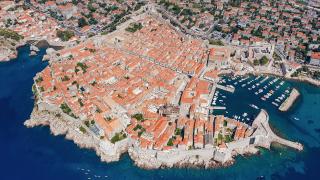
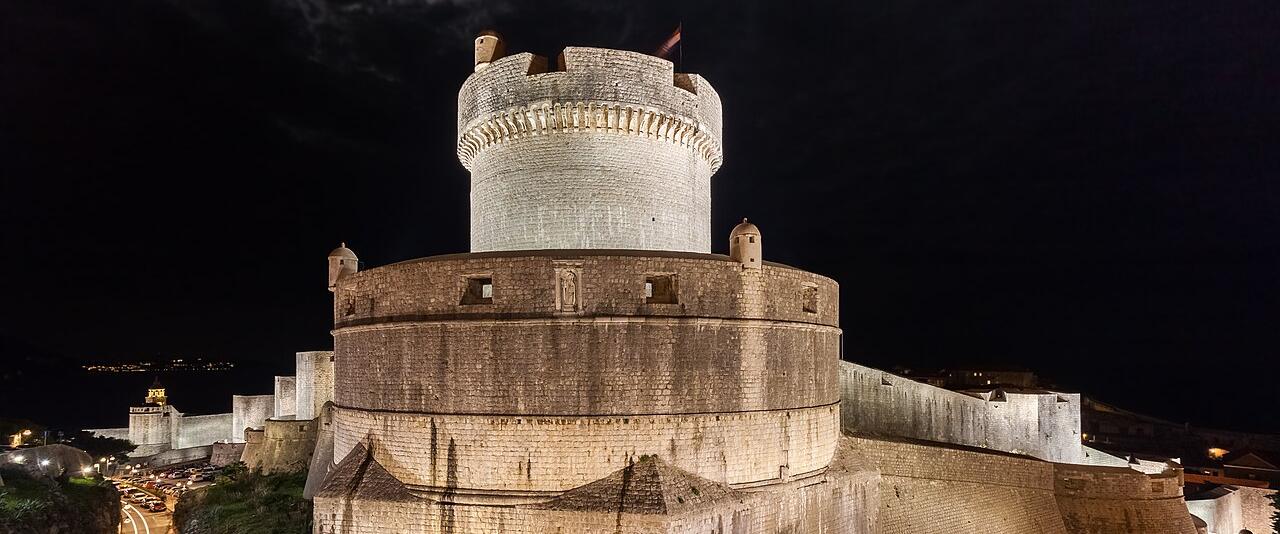
Dubrovnik is the pearl of the Adriatic: white limestone walls, a marble main street polished by centuries of feet, and a backdrop famous from Game of Thrones. The same city once traded in slaves, tied offenders to the column in its main square, and was flattened by an earthquake in a single morning. In the 20th century it saw prisoners taken to an island and shot, and in 1991 it was shelled from the hills above while the world watched. Today it struggles with a different kind of siege, from the crowds that come to see it.
Most of these chapters left something behind you can still find: the quarantine buildings by the Ploče gate, a map of shell hits by the Pile gate, the cells under the Rector's Palace. This guide goes through them in order, from the plague years to the present, and tells you where to see each one.
1377: Plague and the First Quarantine
The Black Death reached Dubrovnik, then the Republic of Ragusa, in the first half of 1348. Chroniclers recorded the deaths of between 110 and 273 nobles and of thousands of ordinary people; historians estimate the city lost about a quarter of its population.
Ragusa answered with one of the first public-health laws in Europe. On 27 July 1377 its Great Council decreed that anyone coming from places struck by plague could not enter the city until they had spent a month in isolation, first on the nearby islets or in Cavtat. The rule set 30 days; the 40-day quarantena, which gave quarantine its name, came later. Venice adopted the idea only in 1423.
The plague came back again and again. The outbreak of 1526–27 killed more than 20,000 people across the Republic, and the government moved out of the city to Gruž to escape it. The last epidemic was in 1815–16.
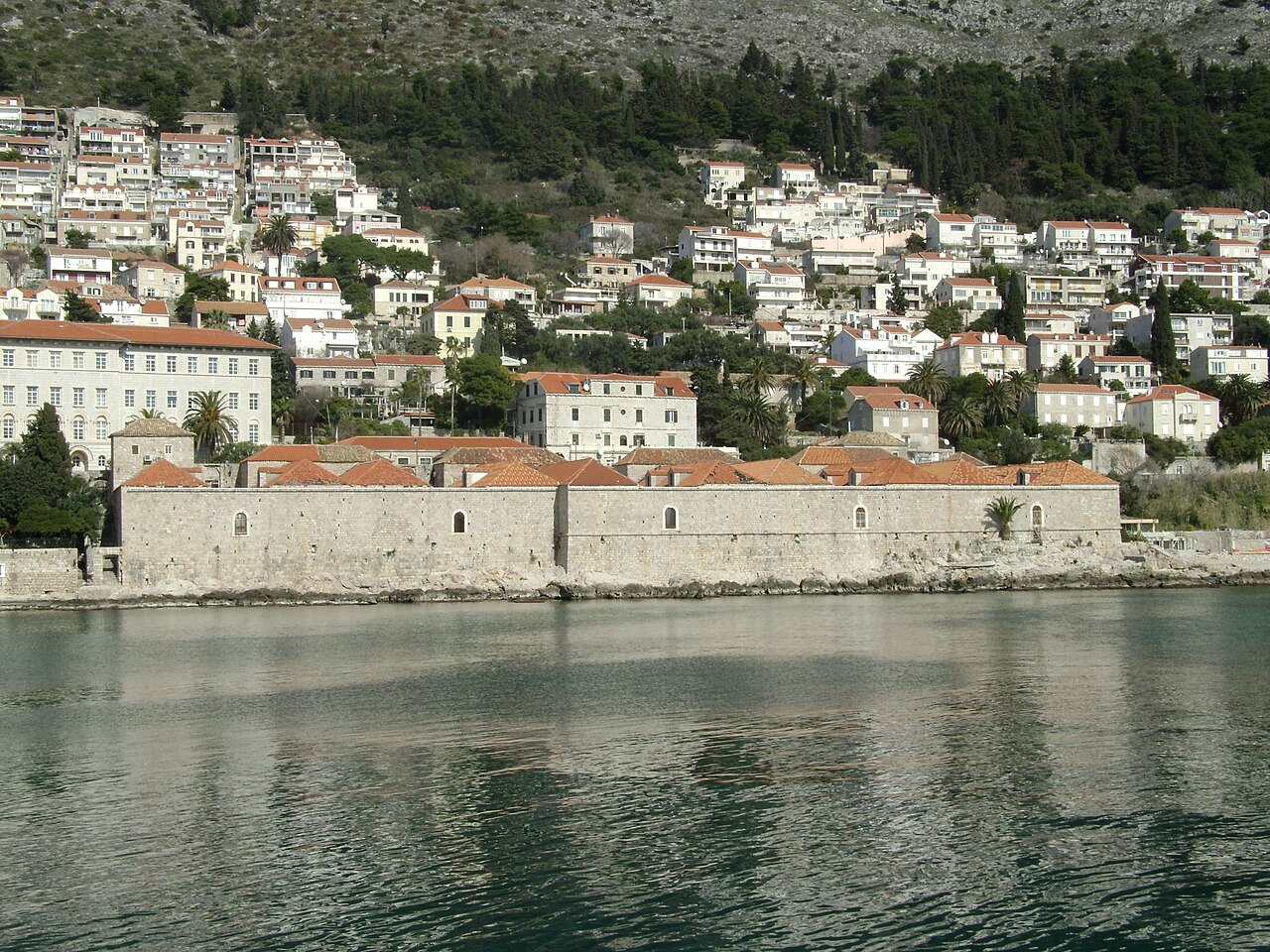 The Lazareti outside the Ploče gate, where travellers and goods from the east were held in quarantine. Image: Lasta, Public domain, via Wikimedia Commons.
Where to see it today: the Lazareti, the long row of stone quarantine buildings just outside the Ploče gate at Frana Supila 10, were built between 1627 and the 1640s. Traders and their goods arriving overland from the Ottoman Empire were held here. Today the courtyards house folk-dance shows, artists' workshops, a club and a small exhibition on quarantine.
1416: Ending the Slave Trade
Medieval Ragusa grew rich as a trading port between the Balkans and Italy, and part of that trade was in people. Slaves, mostly from Bosnia, were bought in the hinterland and sold through Dubrovnik to Venetian merchants. The city's notarial records list them like any other goods; in November 1389 a Bosnian boy named Milko changed hands for four ducats.
On 27 January 1416 the Republic banned the trade: buying, selling and shipping slaves, including on Ragusan ships, was forbidden. It was one of the earliest such bans in Europe, though it did not end household servitude in the city.
Where to see it today: there is no memorial. Over the gate of the Lovrijenac fortress the Republic carved its creed: Non bene pro toto libertas venditur auro, "freedom is not to be sold for all the gold in the world".
Justice in the Republic
The Republic was proud of its laws and enforced them in public. Orlando's Column, raised in front of St Blaise's Church in 1418, served as the pillory. Proclamations were read from it, offenders were tied to it and whipped, and in 1416 a port porter who had let in travellers from plague areas was tied to the pillory and had his hair and beard burned. At its base is carved the Ragusan ell, the official measure of length, 51.2 centimetres.
 Orlando's Column in front of St Blaise's Church, once the city's pillory. Image: Richard Mortel from Riyadh, Saudi Arabia, CC BY 2.0, via Wikimedia Commons.
Executions took place outside the walls, mostly at Danče, west of the city. Most of the condemned were hanged; nobles and women were beheaded. Nearly 100 people were executed in the 18th century alone. Ragusa was also early in using prison as a punishment in its own right, and its cells were in the government's own building, the Rector's Palace.
 The atrium of the Rector's Palace. The Republic's prison cells were on the lower floors. Image: JoJan, CC BY 3.0, via Wikimedia Commons.
Where to see it today: Orlando's Column stands on Luža Square at the end of the Stradun. The Rector's Palace, now the Cultural History Museum, shows a courtroom and prison cells. It is open daily from 9:00 to 18:00 between April and October, and from 9:00 to 16:00 the rest of the year, closed on Mondays in winter.
1546: The Ghetto
In 1546 the Republic confined the city's Jews to a single narrow street off the Stradun, Žudioska ulica ("Jewish Street"), which was locked at night. The community kept its synagogue there, on the upper floor of a house.
Where to see it today: the synagogue on Žudioska ulica is one of the oldest Sephardic synagogues in Europe still in use, with a small museum.
 The building on Žudioska ulica that houses the synagogue. Image: Alaexis, CC BY-SA 4.0, via Wikimedia Commons.
6 April 1667: The Great Earthquake
At about eight in the morning on 6 April 1667, an earthquake of about magnitude 6.4 struck the city. A tsunami hit the harbour, and fires burned through the ruins for almost 20 days. About 2,000 people died in the city, among them the rector, Šimun Getaldić, and up to 3,000 or more across the Republic. Almost every building along the Stradun was destroyed, and the Franciscan library burned. The Rector's Palace and the Sponza Palace survived, damaged.
 Dubrovnik before the earthquake of 1667, in a 17th-century painting. Image: Unknown 17th century painter, Public domain, via Wikimedia Commons.
The city rebuilt in Baroque style under a building law that gave the Stradun its uniform look: a shop on the ground floor with an arched door and window, living space above, and the kitchen in the attic, where a fire would do least damage.
Where to see it today: walk the Stradun. Its matching house fronts are the rebuilt city of the 1670s. The Sponza Palace and the Rector's Palace are among the few buildings that survived.
1806–1808: The End of the Republic
The Republic survived for more than 450 years by diplomacy. It could not survive Napoleon. French troops occupied the city in May 1806, and a Russian and Montenegrin army promptly besieged them. Over four months about 3,000 cannonballs were fired into the city, and the besiegers burned the suburbs of Gruž, Pile and Ploče and the nobles' summer villas. On 31 January 1808 the French abolished the Republic altogether.
The French built Fort Imperial on Mount Srđ, above the city, between 1806 and 1812. It would matter again in 1991.
Where to see it today: Fort Imperial on Mount Srđ, reached by cable car or by the zig-zag path from the road above the city.
1942–1944: Internment and Daksa
In the Second World War Dubrovnik was nominally part of the fascist Independent State of Croatia but held by the Italian army. In late 1942 the Italians interned the Jews in their zone, including refugees from elsewhere in Yugoslavia, in camps at Gruž, on the island of Lopud and in the hotels at Kupari, a few kilometres south. The internment kept them out of German hands; in 1943 they were moved to the island of Rab, and after Italy surrendered most escaped with the Partisans.
 The ruined Grand Hotel at Kupari, used as an internment site in 1942–43 and wrecked again in 1991. Image: Pudelek (Marcin Szala), CC BY-SA 3.0, via Wikimedia Commons.
The Partisans entered Dubrovnik on 18 October 1944 and arrested more than 300 people. On the night of 24–25 October, without trial, they took prisoners to the small island of Daksa, just off the harbour of Gruž, and shot them. Among the dead were the city's mayor, Niko Koprivica, and a priest, Petar Perica. For 65 years the killings could not be discussed. In 2009 the grave was found and opened: forensic scientists counted at least 53 men, most shot in the head. Eighteen were identified through DNA; the rest are still unnamed. The victims were reburied in 2010, and no one was ever tried.
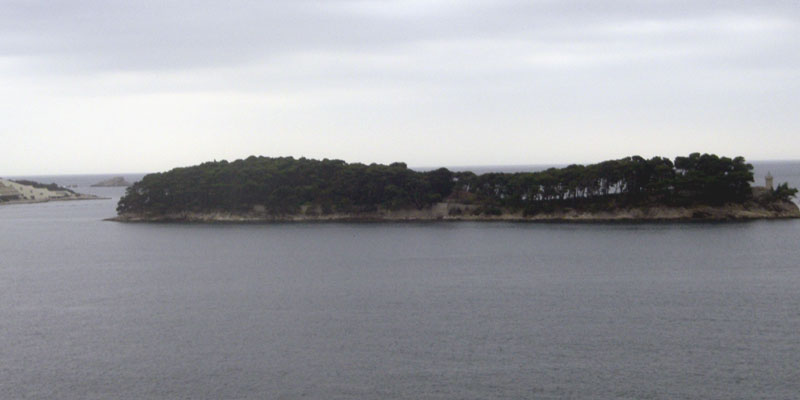 The island of Daksa, off the harbour of Gruž. Image: Ante Perkovic, CC BY 3.0, via Wikimedia Commons.
Where to see it today: Daksa is privately owned and can only be seen from the water or from the Franjo Tuđman Bridge above Gruž. A memorial cross stands on the island, and a commemoration is held each year in late October.
1979: The Second Great Earthquake
On 15 April 1979 an earthquake centred off the Montenegrin coast killed 136 people in Montenegro and Albania. No one died in Dubrovnik, but more than a thousand buildings in the Dubrovnik area were damaged, among them the city walls and the Rector's Palace. In October the same year, the old city was added to UNESCO's World Heritage list.
1991–1992: The Siege
When Croatia declared independence in 1991, the Yugoslav People's Army and Montenegrin forces attacked the Dubrovnik area. From 1 October 1991 the city was cut off by land and sea and shelled from the hills. Between 82 and 88 civilians and 194 Croatian soldiers were killed in the siege, and thousands fled by boat.
The worst day was 6 December 1991. From before six in the morning until almost noon, the old city was hit by hundreds of shells and missiles. Thirteen civilians were killed, nine buildings burned to the ground, and the Inter-University Centre's library of 20,000 books was destroyed. Among the dead was Pavo Urban, a young photographer killed by shrapnel while photographing the shelling; his last frames survive. The same day, a small garrison of defenders held off an attack on Fort Imperial on Mount Srđ.
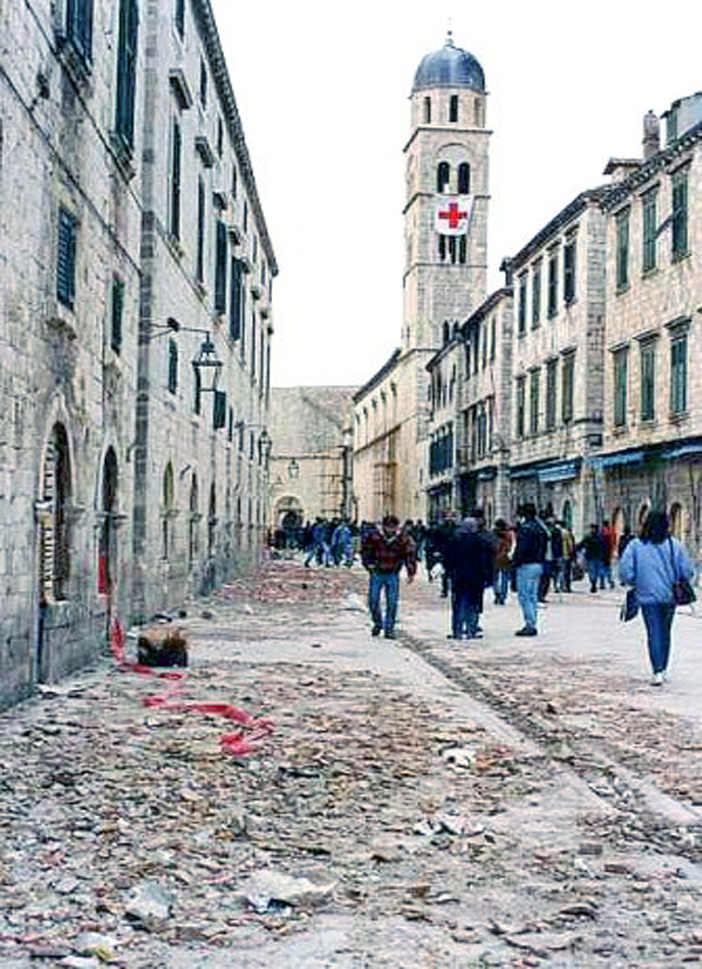 Rubble on the Stradun during the siege, 1991. Image: Peter Denton from Teddington, UK, CC BY-SA 2.5, via Wikimedia Commons.
By the end of the siege, 594 of the old city's 824 buildings, about 72 percent, had been hit. The war crimes tribunal in The Hague later convicted two officers for the shelling of 6 December: General Pavle Strugar and Admiral Miodrag Jokić. Both have since died.
Where to see it today:
- At the Pile gate, where the Stradun begins, a map on the wall marks every shell that hit the old city.
- The new roof tiles, brighter orange than the old ones, show where roofs were rebuilt; you see them best from the city walls.
- The Homeland War Museum in Fort Imperial on Mount Srđ. It is open daily, from 8:30 to 22:00 in summer and from 9:00 to 17:00 in winter.
- The Memorial Room of the Dubrovnik Defenders in the Sponza Palace, with portraits of the defenders who died. Entry is free.
 The map of shell damage by the Pile gate. Image: LBM1948, CC BY-SA 4.0, via Wikimedia Commons.
1996: The Crash on Stražišće
On 3 April 1996 a US Air Force plane carrying the US Secretary of Commerce, Ron Brown, and a business delegation flew into a hillside while approaching Dubrovnik airport in a storm. All 35 people on board died, including two Croatians.
Where to see it today: a steel cross stands at the crash site on Stražišće hill, about 3 kilometres north of the airport. In the old city, the Ron Brown Memorial House shows portraits of the victims.
Today's Siege
About 1,200 people now live inside the walls, down from about 5,000 before the war. Many of the old town's flats are holiday rentals, and visitor numbers rose sharply after Game of Thrones began filming here, to more than a million a year. In 2016 and 2017 UNESCO warned that the city's World Heritage status was at risk.
 Cruise ships at the port of Gruž. Image: dronepicr, CC BY 2.0, via Wikimedia Commons.
The city has pushed back:
- Cruise ships. The port now books no more than two large ships at Gruž and one anchored off the old town at a time, and turns dozens of calls away each season.
- Rules in the old town. Swimwear and going shirtless in the old town have been banned since 2016, with fines; so are climbing on monuments, sleeping in public and drinking near monuments.
- Holiday lets. New holiday apartments have been banned in residential zones since 2023.
- The suitcase myth. Despite the stories, Dubrovnik has never banned wheeled suitcases.
How to visit: come early in the morning or in the evening, when the cruise passengers have gone. Cover up when you leave the beach, and remember that the old town is also somebody's home.
How to See Dark Dubrovnik Respectfully
A self-guided walk, about 3 km. Start at the Pile gate and the shell-damage map. Walk the Stradun to the synagogue on Žudioska ulica, then on to Luža Square for Orlando's Column and the Memorial Room in the Sponza Palace. Visit the cells in the Rector's Palace, then leave through the Ploče gate to the Lazareti. Finish by taking the cable car up Mount Srđ to Fort Imperial and the Homeland War Museum, at sunset.
Further afield:
- The island of Daksa, seen from the Franjo Tuđman Bridge.
- The ruined hotels at Kupari, a short drive south.
- The Ron Brown memorial cross on Stražišće hill.
Dates the city remembers:
- 3 February: the Feast of St Blaise, the city's patron.
- Late October: the Daksa commemoration.
- 6 December: the anniversary of the 1991 shelling.
A few ground rules. The Memorial Room is a place of mourning; keep your voice down. Don't climb the walls or monuments for photos. And when you film the Stradun, remember that the people around you may have lived through the siege.

_(30150111635).jpg)
.JPG)


.jpg)


.jpg)