







- Where
- Krka National Park, Dalmatia
- Directions
- Directions
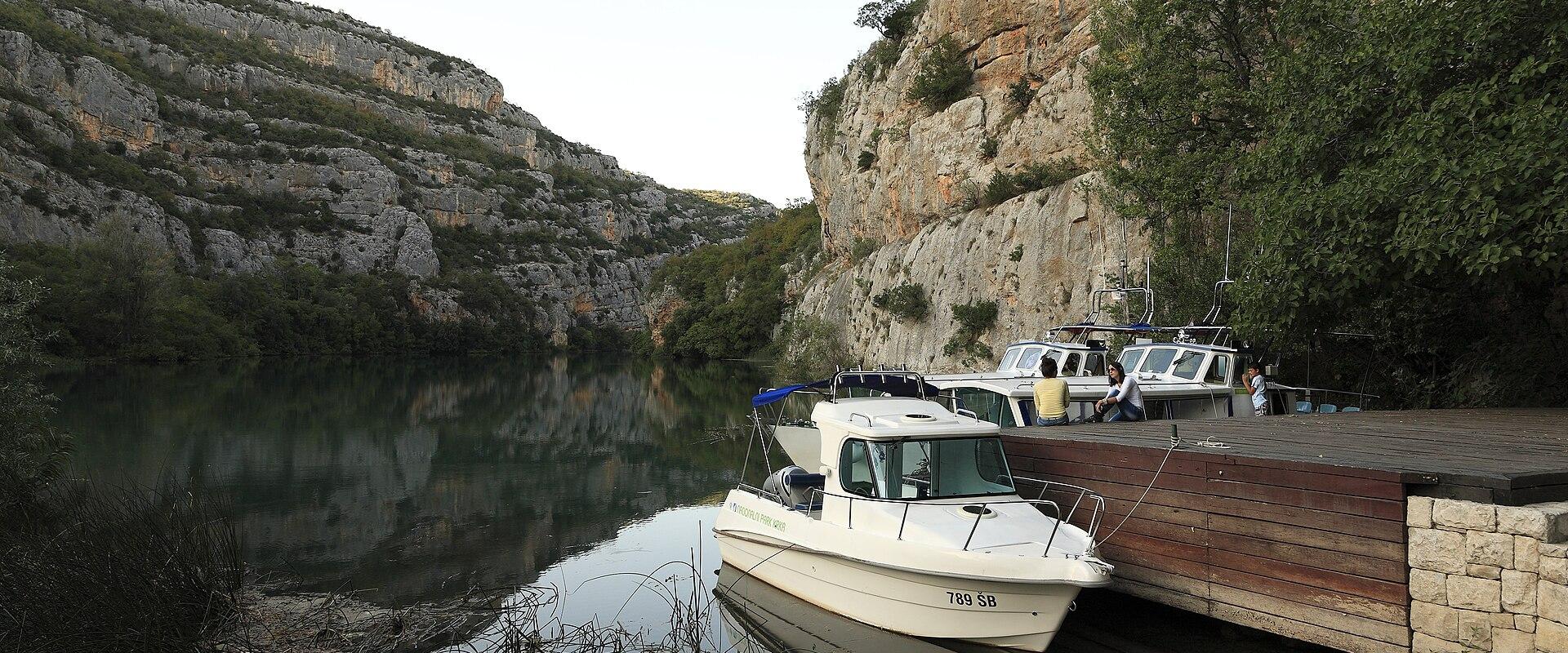
Roški Waterfall, known in Croatian as Roški slap, is one of the main cascades of the Krka River in Krka National Park, in Šibenik-Knin County. The Krka flows through a deep karst canyon and drops from the interior toward the Adriatic in a series of travertine barriers, and the river's seven major waterfalls are among the park's best-known features. Roški Waterfall lies in the upper course, upstream of Lake Visovac, and it is notable for its length: instead of a single drop, the water spreads over a broad, stepped stretch of cascades, islets and small pools.
Travertine is the key to the scenery. Calcium carbonate carried by the river is deposited on moss, algae and plants, building soft barriers that slowly grow and reshape themselves over thousands of years. The plants that anchor the deposits give the waterfall its green colour, and the water often looks pale turquoise against the moss. Below the cascades the river runs into calmer reaches, and above them it spreads over wide, shallow shelves. Because the river is fed by karst springs, its flow is strongest in spring and after rain, and quieter in late summer.
A wooden walkway and a short trail allow visitors to move along and above the falls, with viewpoints that show the cascades from several angles. Traditional watermills once stood along the Krka, and the park's upper stretches keep that rural heritage in view, along with the quiet atmosphere that comes from fewer crowds than at Skradinski Buk, the best-known and most visited waterfall of the park. The area is also home to birds, dragonflies and fish, and the walkway gives a chance to watch them without disturbing the habitat.
The waterfall sits in the same part of the park as other upstream sights. The island monastery on Visovac, the Manojlovac Waterfall, the ruined Ključica Fortress and the Roman remains at Burnum all belong to the wider upper Krka area, and some visitors combine two or three of them in one day. As in the rest of the park, swimming is not permitted, and visitors should stay on the marked paths.
The place suits nature lovers, photographers and families who want a quieter alternative to the better-known lower sections. Wear sturdy shoes, carry water, and check current access arrangements and ticket rules with the park before travelling, since transport and entrance details change by season.
Categories
More photos coming soon
Nearby Attractions
Other places to visit in Krka National Park
Manojlovac Waterfall
Highest waterfall in Krka National Park, Croatia
Natural Wonders

Kljucica Fortress
Medieval fortress atop Skradin hill viewpoint
History & Heritage · Urban Exploration

Krka National Park
Karst waterfalls and ancient cultural heritage
Activities & Adventure · Natural Wonders
Visovac Island
Historic Franciscan monastery on Visovac Lake
Coastal & Maritime · Natural Wonders
Questions people ask
Quick Facts
Best Time to Visit
May, June, September, and October offer pleasant weather, full waterfalls, and fewer crowds; spring and early autumn are ideal for hiking and boat tours.