







St. Dominus Cathedral
Ancient Roman mausoleum turned cathedral in Split
The Cathedral of St. Domnius, called Katedrala sv. Duje in Croatian, stands in the middle of Diocletian's Palace in Split, Croatia, and it is one of the oldest cathedrals in Europe and the world that still serves in its original building. The name St. Dominus sometimes appears for it, but the saint is Domnius, known locally as Sveti Duje, the first bishop of the Roman city of Salona and the patron of Split. The building is remarkable above all for its history: it began as a mausoleum built for the Roman Emperor Diocletian, and it was converted into a church in the 7th century, when refugees from Salona settled within the palace walls.
The structure is an octagon, a form favoured for imperial tombs, with a dome and an inner ring of columns that is partly original. Diocletian died around the year 311, and his tomb, richly decorated in the Roman style, stood at the centre of the palace complex. When Christianity became dominant, the mausoleum, ironically, was turned into a Christian church dedicated to a martyr killed during Diocletian's persecution of the Christians, so the building's own story has a striking twist. The relics of St. Domnius and of St. Anastasius, another martyr of Salona, are kept in the cathedral, and the feast of St. Domnius on 7 May is the biggest religious and civic celebration of the year in Split.
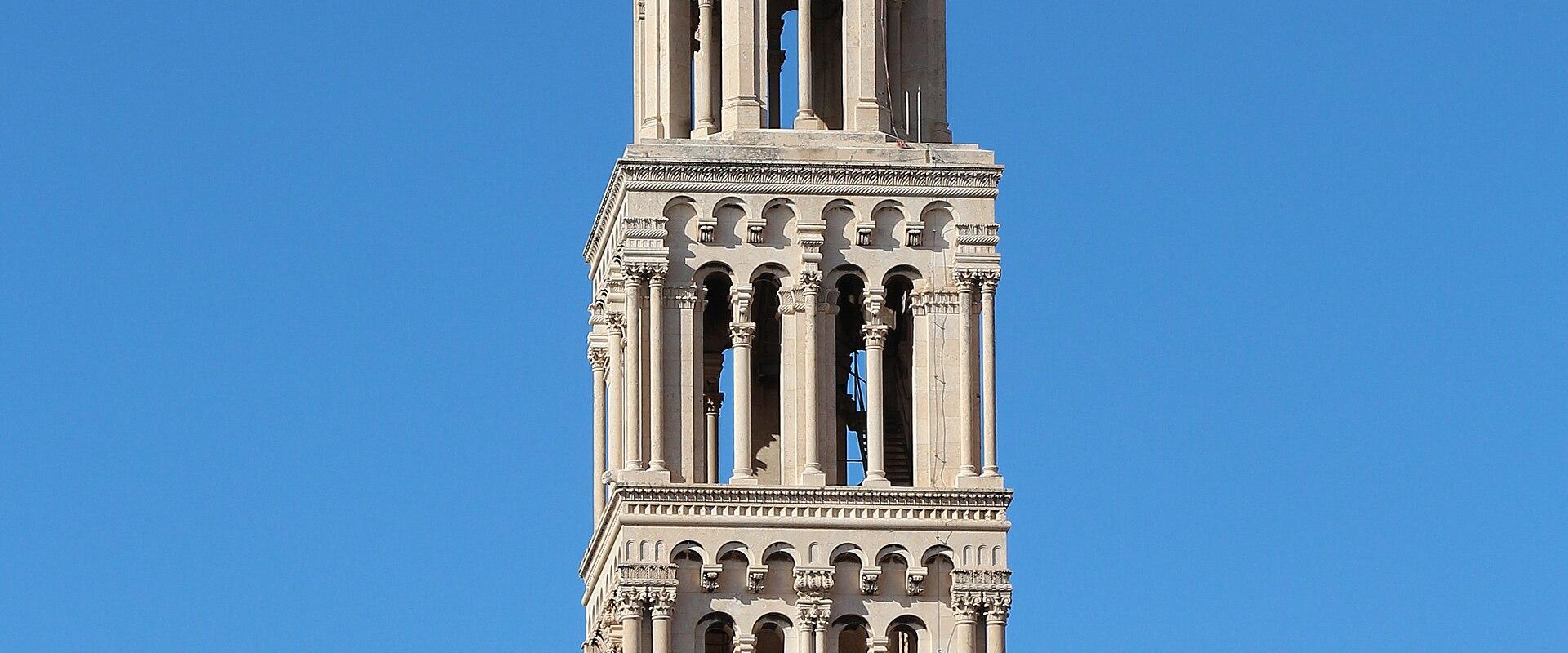
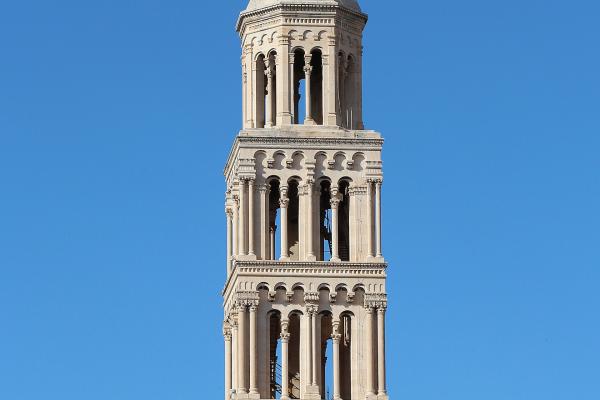
Inside, the visitor can see how many layers of art and architecture have accumulated. Corinthian capitals and carved friezes recall the Roman builders, the choir stalls and altars show medieval and Baroque work, and the wooden doors carved by Andrija Buvina in the early 13th century present scenes from the Gospels in a dense, expressive style. The Romanesque bell tower beside the cathedral rises some 57 metres above the old town and is the best-known viewpoint in Split, with a climb up narrow stairs and a view over the rooftops of the palace, the harbour and the Adriatic islands. Parts of the tower have been rebuilt over the centuries.
A visit usually includes the cathedral, the crypt, the treasury, where precious liturgical objects are kept, and the neighbouring baptistery, the former Temple of Jupiter, a Roman temple later reused as a church. The Peristyle, the open square in front of the cathedral, is the centre of the palace and a place to sit and watch the life of the city. The Museum of Croatian Archaeological Monuments, the Galerija Meštrović and the Riva are all within reach.
Opening times change with services and the season, and dress should be modest. The cathedral suits history lovers, architecture fans and anyone who wants to see how Rome and Christianity meet in one building.
Categories
More photos coming soon
Nearby Attractions
Other places to visit in Split

Frequently Asked Questions
Quick Facts
Best Time to Visit
May to June and September to October offer warm weather, fewer crowds, and ideal conditions for sightseeing, beaches, and exploring Split’s vibrant old town.