







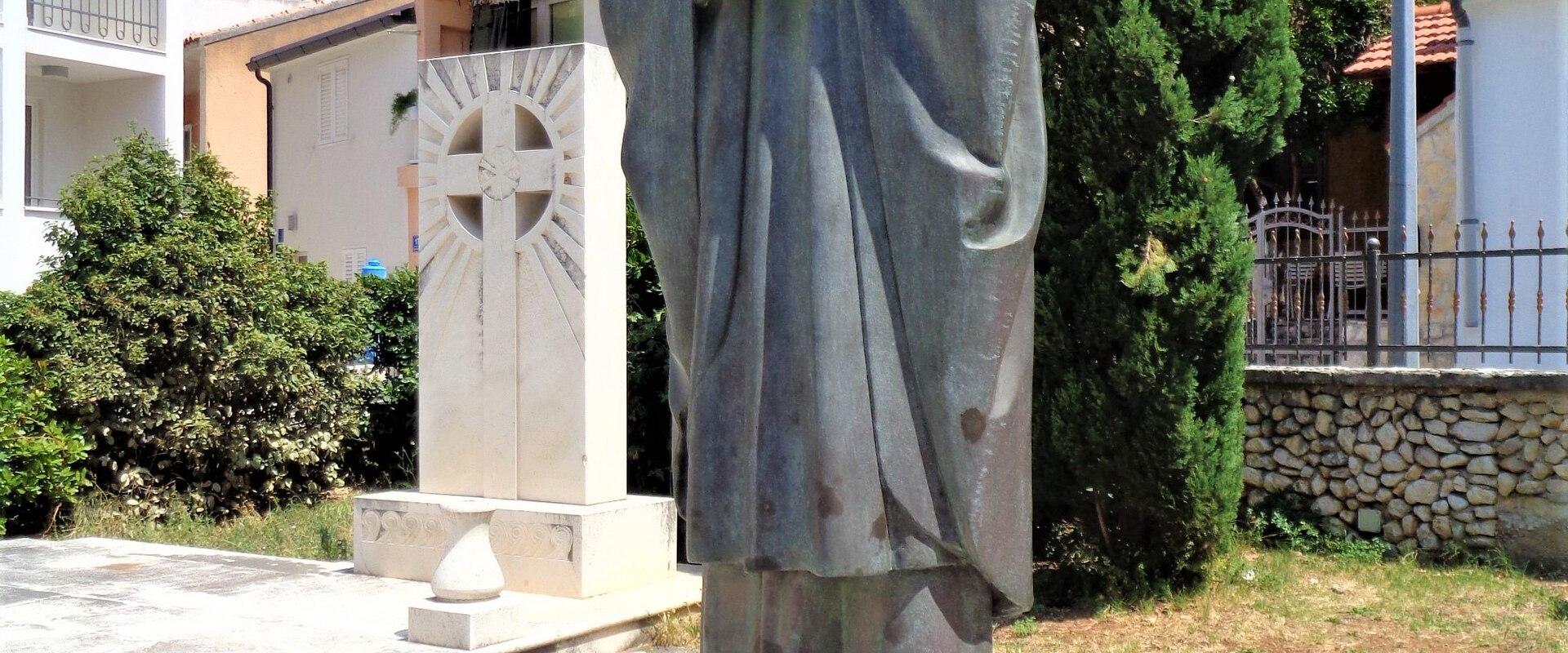
Statue of Cardinal Alojzije Stepinac
Statue honoring Cardinal Stepinac’s wartime courage
The statue of Cardinal Alojzije Stepinac in Novalja is a public monument to one of the most significant, and most debated, figures of 20th-century Croatian history. Public sources give few details about this particular statue, such as its sculptor or its date of unveiling, so it is best understood as a local tribute set in a public space in the town, in keeping with the wide respect that Stepinac enjoys among Croatian Catholics. Novalja lies on the island of Pag, and the statue is one of several cultural stops that sit beside the island's better-known beaches and nightlife.
Alojzije Stepinac, born in 1898 in the village of Krašić, became Archbishop of Zagreb in 1937 and led the Catholic Church in Croatia through the Second World War and the first years of communist Yugoslavia. His record is complex. He is remembered by many for his efforts to protect persecuted people, for his sermons condemning racial persecution and violence, and for his opposition to totalitarian rule. Critics, however, point to his early dealings with the Independent State of Croatia, the wartime regime allied with the Axis powers, and the question of how strongly the Church spoke out against it. In 1946, a communist court in Yugoslavia convicted him on charges that most historians regard as politically driven. He spent years in prison and then under house arrest in Krašić, was named a cardinal by Pope Pius XII in 1953, and died in 1960.
Pope John Paul II beatified him in 1998 during a visit to Marija Bistrica, and his tomb in Zagreb Cathedral has become a place of pilgrimage. Statues, streets and squares named after him appear in many Croatian towns, and monuments like the one in Novalja are the focus of local commemorations on his feast day, 10 February, the anniversary of his death.
A visit here is brief and quiet. The statue is in an open public place, with no opening hours and no entrance fee, and it can be seen at any time. Visitors may wish to pause, read any inscription and reflect on the complicated history it represents. It is easy to combine with a walk through downtown Novalja, where there are cafés, shops and the Roman Aqueduct, a significant ancient monument, as well as the Life on Mars Trail, which offers a very different, lunar-like landscape. Further afield lie Zrće Beach and its clubs, and Plaža Ručica for a quieter swim.
The statue suits those interested in religious history, modern Croatian history and local heritage. Treat the site with respect, and allow around ten minutes.
Categories
More photos coming soon
Nearby Attractions
Other places to visit in Novalja

Frequently Asked Questions
Quick Facts
Best Time to Visit
Late June to late August offers hot weather, warm sea, and lively nightlife; May, June, and September are quieter with pleasant temperatures for outdoor activities.