







Temple Of Jupiter
6th-century Baptistery in a 3rd-century Roman temple
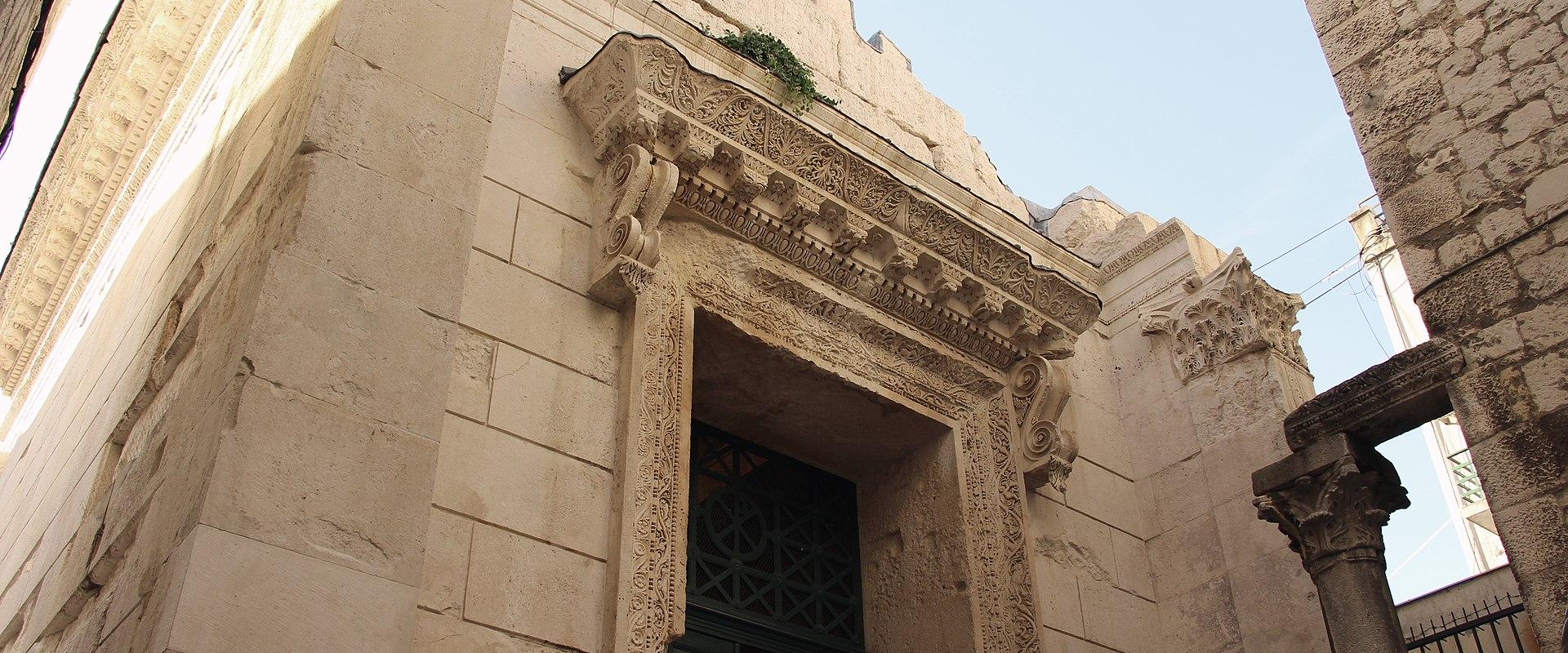
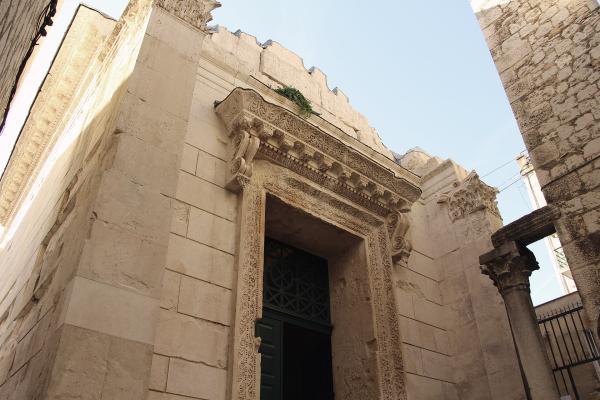
The Temple of Jupiter is a small, remarkably well-preserved Roman temple inside Diocletian’s Palace in Split, in Dalmatia, in Croatia, standing a short way west of the Peristyle, the central courtyard of the palace. It is one of the best-preserved Roman temples in this part of Europe, and it has the unusual distinction of having served for about fifteen hundred years as a Christian Baptistery.
The palace was built as a retirement residence for the Roman Emperor Diocletian between about 295 and 305 AD. Diocletian, who had risen from humble origins in nearby Salona to rule the empire, planned a fortified compound on the coast that combined a luxurious residence, a military camp and a religious precinct. The temple of Jupiter, the chief of the Roman gods, with whom Diocletian had a special link, since he presented himself as the earthly representative of Jupiter, was one of the key buildings in the religious quarter. It stood opposite the emperor’s mausoleum, which is now Split’s cathedral, on the other side of the Peristyle, so that the two together formed a ceremonial axis.
The temple is compact and solid. It stands on a podium, with a portico at the front that was once supported by columns, and a rectangular chamber of cut stone behind. Inside, the roof is a barrel vault covered with coffers, deep square panels with carved decoration, and the stones are fitted so precisely that the vault has stood for nearly seventeen centuries. The scale is intimate, and in the dimness the carved ceiling, with its geometric pattern, is the most striking sight. To reach the temple, many visitors pass through a very narrow alley known by the Croatian name Pusti me proć, which means Let me pass, one of the narrowest streets in the old town.
In the sixth or seventh century, when the palace was taking on new life as a town after the fall of Salona, the pagan temple was converted into a Christian baptistery, dedicated to St. John the Baptist, and it kept that function through the Middle Ages. A large bronze statue of St. John the Baptist by the sculptor Ivan Meštrović stands inside, a work of the twentieth century that adds a modern artistic element to the ancient setting. At the entrance, a damaged Egyptian Sphinx of black granite, brought from Egypt, is one of several sphinxes that Diocletian imported to decorate the palace, a reminder of the eclectic tastes of the Roman world.
Visitors will find that the temple is part of the UNESCO-listed palace complex, and it is generally open as part of visits to the palace, with a small entrance fee in season. It offers a quiet, reflective space compared with the busier areas of the old town, and it suits anyone interested in Roman architecture, early Christianity and art. Visit early in the morning or late in the day to avoid the crowds.
Categories
More photos coming soon
Nearby Attractions
Other places to visit in Split

Frequently Asked Questions
Quick Facts
Best Time to Visit
May to June and September to October offer warm weather, fewer crowds, and ideal conditions for sightseeing, beaches, and exploring Split’s vibrant old town.