Why Trogir
Trogir is a small walled town on an islet between the Croatian mainland and the island of Čiovo, about 27 km west of Split. Bridges connect it to both sides. Greek colonists from the island of Vis founded it as Tragurion in the 3rd century BC. Its present street plan and most of its buildings date from the Middle Ages and the centuries of Venetian rule that followed.
UNESCO added the Historic City of Trogir to its World Heritage list in 1997, citing it as an exceptionally well-preserved example of urban continuity. The old town is small enough to see in a few hours, which makes it one of the easiest day trips from Split.
Getting there from Split
- By bus: suburban buses run frequently between Split and Trogir, passing Split Airport, which is only about 6 km from Trogir. Intercity buses heading north along the coast also stop at Trogir. The bus station is just across the bridge from the old town's main gate.
- By boat: in summer, a passenger boat service runs between Split's harbour and Trogir. It is slower than the bus but avoids coastal traffic. Check the season's timetable.
- By car: the drive takes 30–45 minutes, depending on traffic. The old town itself is car-free, and parking nearby fills up in summer.
Because Trogir is so close to the airport, some travellers spend their first or last night here instead of in Split.
The Cathedral of St Lawrence
The cathedral is the main reason to visit. It was begun in 1213, largely completed by the mid-13th century, and finished in stages over the following centuries. Its highlights are:
- Radovan's portal on the west front, finished in 1240 and signed by the master Radovan. It is considered the finest Romanesque work in Croatia. Adam and Eve stand on lions at the sides, and the arches show biblical scenes alongside the labours of the months, illustrated with everyday medieval work such as pig slaughtering and grape harvesting.
- The Chapel of Blessed John of Trogir, a Renaissance chapel created in the second half of the 15th century by Nikola Firentinac and Andrija Aleši. It is lined with sculpted figures of saints and putti.
- The bell tower, about 47 m high, built over two centuries. Its successive storeys show Gothic, Venetian and Renaissance styles. Visitors can usually climb it for a view over the rooftops and the channel.
An entrance fee is charged for the cathedral interior and tower.
Around the main square
The cathedral stands on Trg Ivana Pavla II, the main square, surrounded by other notable buildings:
- The Town Loggia, a covered public hall first recorded in the 13th century, where courts sat and announcements were read. Inside are reliefs by Nikola Firentinac and, from the 20th century, Ivan Meštrović.
- The clock tower and the small church of St Sebastian.
- The Ćipiko palaces, two 15th-century Gothic palaces of one of the town's leading families, opposite the cathedral.
- The Town Hall, with its courtyard and stone staircase.
Spend some time in the narrow lanes around the square. Many houses have carved Romanesque and Gothic windows and doorways, and the town gates on the north and south sides survive.
The Riva and Kamerlengo Fortress
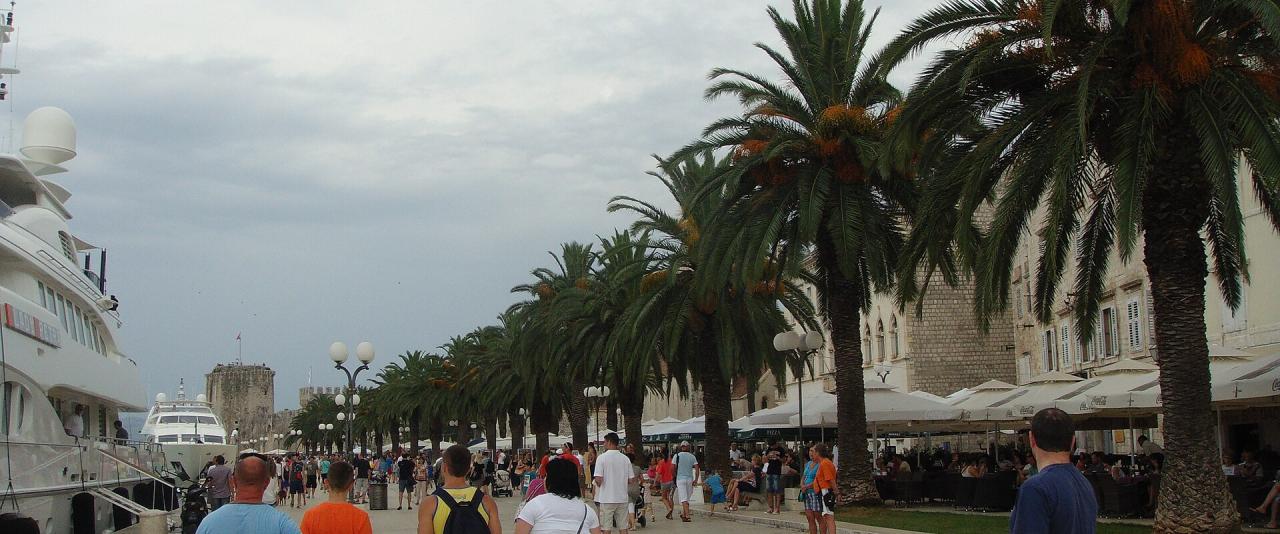
The southern edge of the old town is the Riva, a broad seafront promenade facing Čiovo, lined with cafés and moored yachts. At its western end is the Kamerlengo Fortress, built by the Venetians in the 15th century. You can walk on its walls and climb its tower for views over the town and the channel. In summer, its courtyard is used for open-air concerts and film screenings.
North-west of the fortress, on the edge of a football pitch, stands the Tower of St Mark, another part of the old Venetian defences.
Swimming and Čiovo
Trogir's old town has no beach. Cross the bridge to Čiovo for swimming. The nearest spots are small pebble and rocky beaches within walking distance, and larger beaches such as Okrug Gornji are a short bus or taxi ride away. In summer, small boats also run from the Riva to beaches around Čiovo.
Suggested day plan
- Morning: arrive early, before the tour coaches, and start with the cathedral and the bell tower.
- Late morning: explore the main square, the loggia and the side streets.
- Lunch: eat on the Riva or in a side lane.
- Afternoon: visit Kamerlengo Fortress, then swim on Čiovo.
- Evening: walk along the Riva at sunset before taking the bus back to Split.
Trogir gets very busy in the middle of the day in July and August. If you can, visit in May, June or September, or plan to stay into the evening, when the day visitors have left.