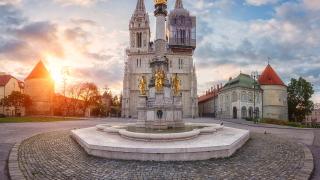


Zagreb doesn't shout. It has no Colosseum and no Eiffel Tower, and many visitors pass through on the way to the coast. Stay a few days and the city shows what it is proud of: a necktie that went round the world, a pen that wrote across Europe, a cannon that tells the time, gas lamps still lit by hand, and a woman who saved thousands of children in the worst years of the 20th century.
Each of these left something you can see, touch or hear. This guide goes through them in order, from the 17th century to the earthquake of 2020, and tells you where to find each one.
The 1600s: The Cravat
During the Thirty Years' War, Croatian soldiers serving in France wore knotted scarves around their necks. The French took up the fashion, and a young Louis XIV wore a lace version from the 1640s. They called it a cravate, after the Croates, and the word went into almost every European language. The colourful details of the story, such as parades before the king, are tradition, but the origin of the word is the accepted one.
Croatia celebrates it every 18 October, Cravat Day, declared by the Croatian parliament in 2008.
 The Cravat Regiment at the changing of the guard in the Upper Town. Image: Nxr-at, CC BY-SA 4.0, via Wikimedia Commons.
Where to see it today: on weekends from April to mid-October, the Cravat Regiment, in 17th-century uniforms and red neckties, changes the guard at noon on St Mark's Square in the Upper Town (not in bad weather). The Croata shop at Ilica 5, in the Oktogon arcade, sells ties as a souvenir of the story.
1669: A University
On 23 September 1669, Emperor Leopold I granted the Jesuit academy in Zagreb the status of a university-level school. The modern University of Zagreb opened on 19 October 1874 and counts its history from 1669, making it one of the oldest continuously operating universities in Europe.
Where to see it today: the university's main building faces Republic of Croatia Square (Trg Republike Hrvatske), at the western end of the Green Horseshoe.
31 May 1731: The Picture That Survived the Fire
The Stone Gate (Kamenita vrata) is the last surviving gate of the medieval town of Gradec. In 1731 a great fire swept through the Upper Town and burned the gate's wooden parts. When the ashes were cleared, a painting of the Virgin and Child that hung in the gate was found almost untouched; only its frame had burned. Zagreb's people took it as a sign, and the gate became a shrine.
 The Stone Gate, with the shrine inside its passage. Image: Alistair Young, CC BY 2.0, via Wikimedia Commons.
In 1999, 31 May, the anniversary of the fire, was made Zagreb's City Day, with Our Lady of the Stone Gate as its patron.
Where to see it today: the Stone Gate links Radićeva street to the Upper Town. Inside the passage, behind an iron grille from 1758, the painting hangs above a crowd of candles; the walls are covered with small stone plaques saying hvala ("thank you") for prayers answered. People stop here on their way to work. Keep your voice down and leave space for them.
1863: The Gas Lamps
Zagreb lit its first gas street lamps on 31 October 1863. Electricity came later, but the city kept more than 200 of the old gas lanterns in the Upper Town, Kaptol and Opatovina, and they are still lit by hand. Every evening at dusk, lamplighters from the city gas company walk the streets with a long pole and light them one by one, and every morning they put them out again, every day of the year.
 One of the Upper Town's hand-lit gas lamps. Image: Jorge Láscar from Australia, CC BY 2.0, via Wikimedia Commons.
Where to see it today: walk the Upper Town around St Mark's Square and along the Strossmayer promenade as it gets dark, and you may meet the lamplighter on the round.
1876: A Cemetery for Everyone
Most European cemeteries of the 19th century belonged to one church. Mirogoj, opened on 6 November 1876 on land that had belonged to the linguist and politician Ljudevit Gaj, was built by the city for everyone: Catholics, Orthodox, Protestants, Jews and Muslims, side by side. The architect Hermann Bollé surrounded it with long arcades and green domes, built between 1879 and 1929. Today it holds about 60,000 graves.
Among them is the grave of Slavoljub Penkala, and the ashes of the chemist Vladimir Prelog, who taught in Zagreb from 1935 to 1941 before moving to Zurich, where he won the Nobel Prize in 1975.
 Candles at Mirogoj on All Saints' night. Image: Therearecrooks, CC0, via Wikimedia Commons.
Where to see it today: Mirogoj, on the hill north of the centre (bus 106 from Kaptol). Entry is free, and it is open from early morning until 20:00 in summer and 18:00 in winter. On the night of 1 November, All Saints' Day, the whole cemetery glows with candles.
1877 and 1890: The Noon Cannon and the Little Funicular
Every day at noon, a cannon fires from the Lotrščak Tower at the edge of the Upper Town. It has done so since 1877, with a break during the First World War. A legend says that a noon shot once hit the lunch of a Turkish army camped across the Sava and sent them fleeing. It is only a legend: the cannon came centuries too late.
At the foot of the tower, the funicular has been carrying people up the hill since 1890. It is just 66 metres long, one of the shortest public funiculars in the world, and the ride takes less than a minute. After a full restoration, with new cars copied from the originals, it reopened in May 2026.
 The funicular climbing from Tomićeva street to the Lotrščak Tower. Image: Diego Delso, CC BY-SA 3.0, via Wikimedia Commons.
Where to see it today: take the funicular from Tomićeva street, off Ilica, then be at the foot of the Lotrščak Tower a few minutes before noon. You can climb the tower for the view (closed Mondays).
The 1880s: The Green Horseshoe
In 1882 the city engineer Milan Lenuci drew up a plan for a U-shaped chain of seven parks and squares around the new Lower Town, with the Botanical Garden at one corner. Finished by 1889, the "Green Horseshoe" gave Zagreb a ring of tree-lined squares, fountains and museums, and it is still the city's front garden.
 Zrinjevac, the first square of the Green Horseshoe. Image: Hijerovit, CC BY-SA 4.0, via Wikimedia Commons.
Where to see it today: start at Zrinjevac, just south of Ban Jelačić Square, with its plane trees and bandstand, and walk the horseshoe past the Art Pavilion to the Botanical Garden.
24 May 1892: Tesla's Advice
The inventor Nikola Tesla, born in the Croatian village of Smiljan, visited Zagreb in May 1892. On 24 May he spoke to the city council in the Old City Hall and urged it to build a power plant using alternating current to light the streets. The council chose a different plan, but Zagreb switched on electric street lighting in late 1907.
 The plaque on the Old City Hall recording Tesla's 1892 visit. Image: Silverije, CC BY-SA 4.0, via Wikimedia Commons.
Where to see it today:
- A plaque on the Old City Hall in the Upper Town, on Ćirilometodska street, quotes Tesla's promise to help the city with advice and action.
- A statue of Tesla by Ivan Meštrović stands at the corner of Masarykova and Teslina streets.
- The Technical Museum Nikola Tesla, Savska cesta 18, runs demonstrations of his inventions on most afternoons and weekend mornings (closed Mondays).
 Ivan Meštrović's statue of Nikola Tesla on Masarykova street. Image: Silverije, CC BY-SA 4.0, via Wikimedia Commons.
1906: Penkala's Pen
Slavoljub Penkala, an engineer born in what is now Slovakia, settled in Zagreb and turned it into a city of inventors. On 24 January 1906 he patented an "automatic pencil", often called the first mechanical pencil, and in 1907 a fountain pen with solid ink. He also patented a hot-water bottle, and in all about 70 to 80 inventions in more than 35 countries. In 1910 a plane he designed flew at Zagreb's Črnomerec field, the first aircraft to fly in Croatia. His pen factory, founded with a partner, still exists today.
 Slavoljub Penkala, Zagreb's prolific inventor. Image: , Public domain, via Wikimedia Commons.
Where to see it today: a model of his 1910 plane is in the Technical Museum Nikola Tesla. His grave is at Mirogoj. Murals of Penkala and Tesla decorate the staircase between the Strossmayer promenade and Katarinin trg in the Upper Town.
1927: A Doctor for the World
Andrija Štampar, a young doctor from Slavonia, believed that a nation's health depended on clean water, schools and housing as much as on hospitals. In 1927 he founded the School of Public Health in Zagreb, with support from the Rockefeller Foundation. After the Second World War he helped write the constitution of the World Health Organization, and in 1948 he was elected the first president of the first World Health Assembly.
 The Andrija Štampar School of Public Health on Rockefellerova street. Image: Runolist, CC BY-SA 4.0, via Wikimedia Commons.
Where to see it today: the School of Public Health, Rockefellerova 4, with a statue of Štampar on its lawn.
1930: Dolac
Zagreb's main market opened in 1930 on a raised square just above Ban Jelačić Square, and it has been the city's kitchen ever since. Under red umbrellas, farmers from the surrounding hills sell vegetables, fruit, cheese and cream, and in the halls below there are meat and fish. At the top of the stairs stands a bronze kumica, one of the countrywomen who carried their produce into the city in baskets on their heads.
 Dolac market above Ban Jelačić Square. Image: Sharon Hahn Darlin, CC BY 2.0, via Wikimedia Commons.
Where to see it today: Dolac, up the steps from Ban Jelačić Square. Come in the morning; the stalls pack up by early afternoon.
 Kumica Barica, the bronze market woman at the top of the Dolac steps. Image: Zagrebist, CC BY-SA 4.0, via Wikimedia Commons.
1941–1945: Diana Budisavljević
During the Second World War, Croatia was ruled by the fascist Ustaše regime, which sent tens of thousands of Serbs, Jews and Roma to concentration camps, among them thousands of children. Diana Budisavljević, an Austrian-born woman who had lived in Zagreb since 1919, organised a rescue. With a small group of helpers, she got children out of the camps, found them food, care and foster families, and kept a card index of more than 12,000 names so that families could find them again. She is credited with saving about 10,000 children.
 Diana Budisavljević, who rescued thousands of children from wartime camps. Image: Unknown authorUnknown author, Public domain, via Wikimedia Commons.
After the war the new authorities took her card index from her, and she was largely forgotten until her diary was published in 2003. The 2019 film The Diary of Diana B., directed by Dana Budisavljević, won the main prize at the Pula Film Festival and brought her story to a wide audience.
Where to see it today: a park in Gornja Dubrava, in the east of the city, has been named after her since 2012. She lived on Trg kralja Petra Svačića, in the Lower Town.
1962: An Oscar for Zagreb
In the 1950s a group of artists at the Zagreb Film studio developed a new style of animation, simpler and more playful than Disney's. In 1962 Surogat (Ersatz), by Dušan Vukotić, won the Academy Award for best animated short film, the first non-American film ever to do so. The "Zagreb School of Animated Film" became famous around the world, and in 1972 the city founded Animafest, now the second-oldest animation festival in the world after Annecy.
Where to see it today: Animafest is held every June. The Zagreb City Museum holds a collection on the Zagreb School.
1993: Dražen Petrović
Born in Šibenik, the basketball player Dražen Petrović became a star with Cibona Zagreb in the 1980s, then one of the first Europeans to succeed in the NBA. He died in a car crash in Germany in 1993, aged 28, and was inducted into the Basketball Hall of Fame in 2002. Zagreb still treats him as one of its own.
 The statue of Dražen Petrović outside the memorial center named after him. Image: CAPTAIN RAJU, CC BY-SA 4.0, via Wikimedia Commons.
Where to see it today: the Dražen Petrović Memorial Center, Trg Dražena Petrovića 3, with a statue of him outside (open Monday to Saturday).
2010: The Museum of Broken Relationships
In 2006 two Zagreb artists, Olinka Vištica and Dražen Grubišić, put together a small exhibition of objects left over from ended love affairs, each with its owner's story. People began sending their own. The exhibition toured the world, and in 2010 it became a permanent museum in the Upper Town. In 2011 it won the Kenneth Hudson Award as the most innovative museum in Europe.
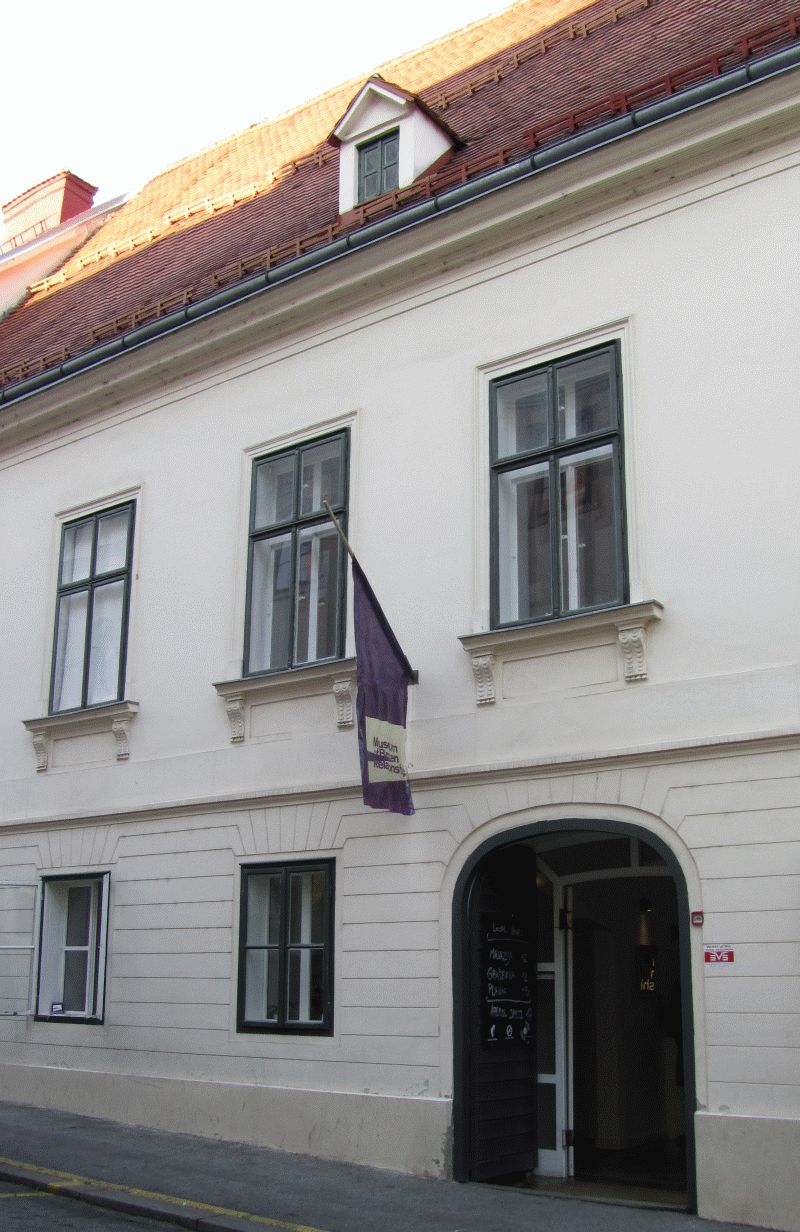 The Museum of Broken Relationships in the Upper Town. Image: Waerfelu, CC BY 3.0, via Wikimedia Commons.
Where to see it today: the Museum of Broken Relationships, Ćirilometodska 2, open daily from 9:00 until 21:00 (22:00 in summer).
22 March 2020: Shaken, Not Broken
At 6:24 on a Sunday morning in March 2020, in the first days of the Covid lockdown, an earthquake of magnitude 5.5 struck Zagreb. More than 26,000 buildings were damaged, and the cathedral lost the top of one of its spires. A 15-year-old girl died.
What followed was a show of solidarity. Hundreds of volunteers, many of them climbers, cavers and rope-access workers, spent weeks on the city's rooftops removing loose chimneys and tiles; one of them died in a fall. Soldiers cleared streets, and the European Union later gave Croatia 683.7 million euros from its Solidarity Fund for the reconstruction.
 Zagreb Cathedral in 2020, after the earthquake. Image: Ex13, CC BY-SA 4.0, via Wikimedia Commons.
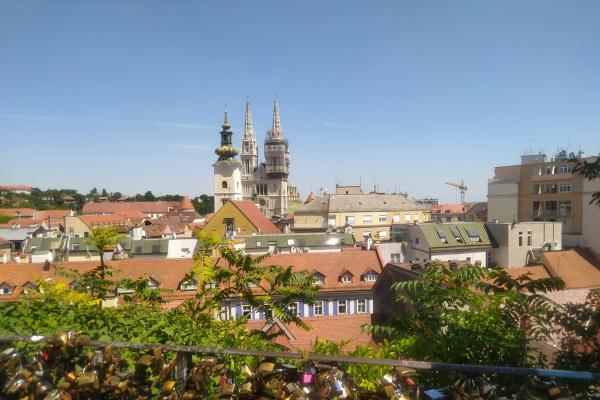
Where to see it today: the Cathedral on Kaptol, still under restoration, and the scaffolding on many Lower Town façades, which tells you how much work remains.
How to See Bright Zagreb
A self-guided walk, about 4 km. Start at Ban Jelačić Square and climb the steps to Dolac in the morning. Walk across to the Cathedral on Kaptol, then up Radićeva to the Stone Gate. Continue to St Mark's Square and the Museum of Broken Relationships, look for Tesla's plaque on the Old City Hall, and be at the Lotrščak Tower for the noon cannon. Ride the funicular down and follow the Green Horseshoe from Zrinjevac to the Botanical Garden, finishing at Tesla's statue on Masarykova street. Come back to the Upper Town at dusk for the gas lamps.
Further afield:
- Mirogoj, especially on All Saints' Day.
- The Technical Museum Nikola Tesla on Savska cesta.
- The Dražen Petrović Memorial Center.
- Park Diane Budisavljević in Gornja Dubrava.
Dates to know:
- 31 May: City Day, with a procession from the Cathedral to the Stone Gate.
- June: Animafest.
- 18 October: Cravat Day.
- Advent: Zagreb's Christmas market was voted the best in Europe three years running, from 2016 to 2018.
 Advent in Zagreb's Upper Town. Image: Branko Radovanović, CC BY-SA 4.0, via Wikimedia Commons.

.jpg)
.jpg)


.jpg)


,_Zagreb,_Croatia.jpg)


