Why two days in Zadar works
Zadar's old town sits on a compact peninsula that you can cross on foot in fifteen minutes, yet it packs in Roman ruins, early medieval churches, Venetian fortifications and two of Croatia's best-known pieces of modern public art. Two days is enough to see the highlights without rushing, enjoy two sunsets on the waterfront and fit in a half-day or full-day trip out of town. This plan assumes you stay in or near the old town and get around on foot.
Day 1 morning: the Forum and St Donatus
Start at the Roman Forum, the large open square at the heart of the peninsula. Founded in the 1st century BC, it was the centre of Roman Iader, and fragments of columns, altars and paving lie scattered around the square. One surviving column on the western side was used in the Middle Ages as a "pillar of shame", where wrongdoers were chained.
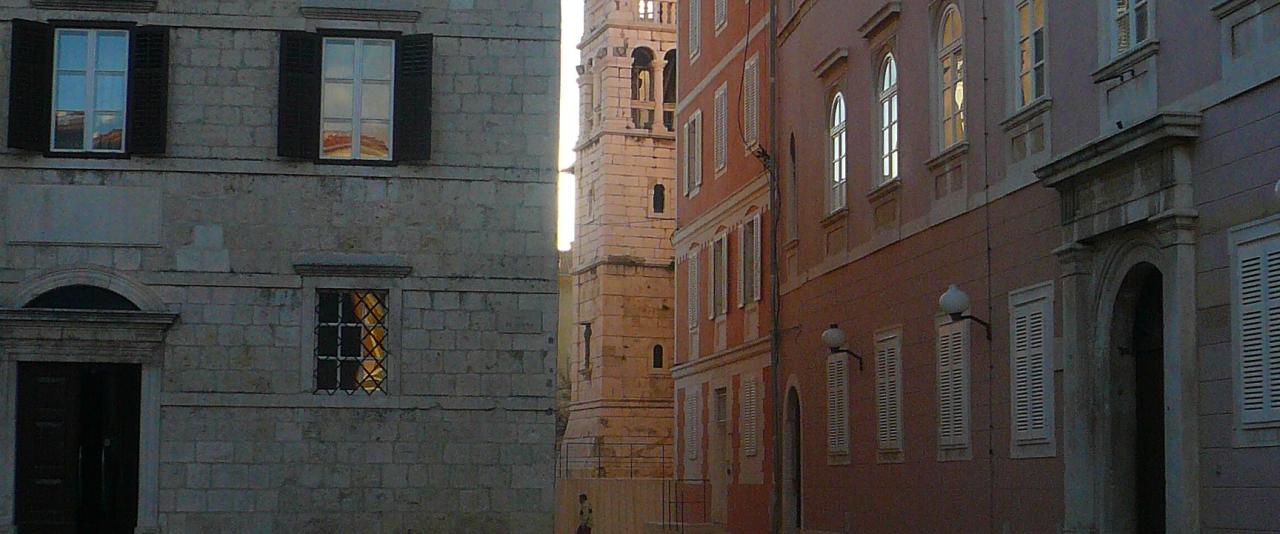
On the edge of the Forum stands the round Church of St Donatus, built in the 9th century and partly constructed from Roman stones taken from the Forum; you can see column pieces in its foundations. It is the city's symbol and now used mainly for concerts. Next to it, the Cathedral of St Anastasia is the largest cathedral in Dalmatia. In season you can climb its bell tower, about 56 metres high, for views over the rooftops, the harbour and the islands.
Close by, the Archaeological Museum and the permanent exhibition of church art at the Benedictine convent of St Mary, known as the Gold and Silver of Zadar, are both worth an hour if you enjoy museums.
Day 1 afternoon: Kalelarga and the walls
After lunch, walk along Kalelarga (Široka ulica), the main street of the old town, which follows the line of the Roman main street. It is lined with shops and cafés and is where locals take their evening stroll.
Head to the eastern side of the peninsula to see the Land Gate (Kopnena vrata), the grand Venetian gateway built in 1543 and decorated with the winged lion of St Mark. Zadar's Venetian defences are part of a UNESCO World Heritage listing shared with other Venetian fortifications in Croatia, Italy and Montenegro. Nearby, the Five Wells Square (Trg pet bunara) has five wellheads built over a 16th-century cistern, and the small Queen Jelena Madijevka Park sits on top of the old bastion above it.
Day 1 evening: the Sea Organ and Greeting to the Sun
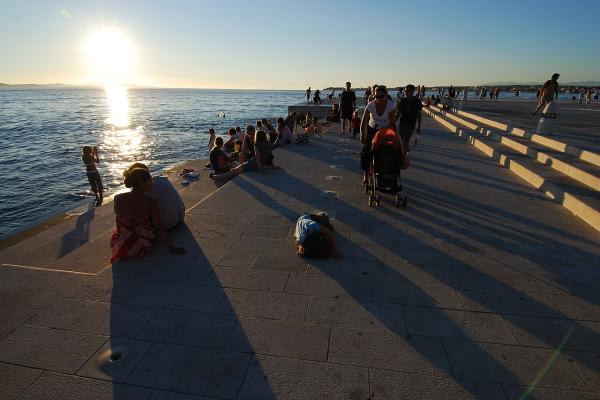
Finish the day on the western tip of the peninsula. The Sea Organ, designed by architect Nikola Bašić and opened in 2005, is a set of marble steps with 35 pipes beneath them; waves push air through the pipes and create constantly changing tones. Sit on the steps and listen as the sun goes down over the islands.
A few metres away is Bašić's Greeting to the Sun, a 22-metre circle of glass panels with solar cells beneath. It absorbs sunlight during the day and after dusk produces a light show across the pavement. It is one of the most popular spots in town at sunset, so arrive a little early.
Day 2: a day trip from Zadar
For your second day, choose one excursion.
Nin, about half an hour north, was an important early Croatian royal and religious centre. It sits on a tiny island in a lagoon and has the 9th-century Church of the Holy Cross, often called the world's smallest cathedral, a statue of the medieval bishop Gregory of Nin, and traditional salt pans with a small salt museum. Sandy beaches nearby, such as the Queen's Beach, are shallow and good for children.
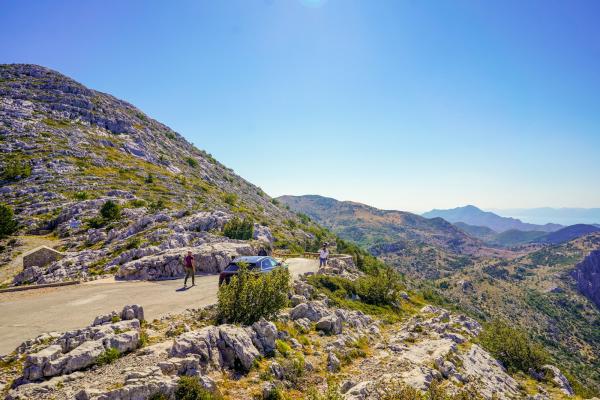
Alternatively, take a boat trip to Kornati National Park, an archipelago of 89 islands, islets and reefs south of Zadar, with bare limestone landscapes and clear water. Tours usually include swimming stops and lunch. Or drive about 45 minutes north to Paklenica National Park for a hike in its limestone canyons.
Day 2 evening: eating and drinking in Zadar
Zadar's food is Dalmatian: grilled fish and squid, black risotto, octopus salad, brudet (fish stew) and pašticada (beef braised in wine and spices). Try Pag cheese from the nearby island of Pag, a hard sheep's cheese with a salty, herby flavour, and finish with a glass of Maraschino, the cherry liqueur that has been made in Zadar for centuries.
For your final evening, cross the harbour in one of the small rowing boats whose oarsmen, the barkajoli, have ferried people across for generations, then walk back along the waterfront for one more sunset.
Practical tips
Zadar airport is about fifteen minutes' drive from the centre, with shuttle buses linked to flight arrivals. Parking inside the old town is very limited, so leave the car outside. Spring and autumn are the most comfortable times for this itinerary, while July and August are hot and busy, so plan sightseeing for mornings and evenings.