Before you start
Dubrovnik's Old Town is small: about 2 km of walls enclose it, and you can cross it on foot in ten minutes. The pleasure is in the detail, and the main problem is crowds. Cruise passengers and coach groups usually arrive mid-morning, so the best times to walk are early morning and after about 5 pm.
The streets are polished limestone and very slippery when wet. Many side lanes are steep stairways, so wear shoes with grip. The route below runs west to east and takes about two hours without the walls, or four to five hours with them.
Pile Gate and Onofrio's Fountain
Start at Pile Gate, the main western entrance. You cross a stone bridge over the old moat and pass under a statue of St Blaise, the city's patron saint. The inner gate dates from the 15th century. On the left as you enter is one of the main entrances to the city walls.
Just inside is the Large Onofrio Fountain, a domed sixteen-sided fountain built in 1438. It was part of a water system designed by the Neapolitan engineer Onofrio della Cava, which brought water into the city from a spring about 12 km away. Next to it is the Franciscan Monastery. Its pharmacy, founded in 1317, is one of the oldest in Europe still operating, and the Romanesque cloister is worth the entry fee.
The Stradun
The Stradun (Placa) is the broad main street that runs straight across the town from Pile to the Luža square. Its uniform stone houses, with shops on the ground floor, were rebuilt to a single plan after the earthquake of 1667, which destroyed most of the city and killed thousands. The narrow lanes to either side are worth short detours. Those to the north climb steeply in steps towards the walls.
Luža Square
The Stradun ends at Luža, the old civic heart of the Republic of Ragusa. Around this square you will find:
- Orlando's Column (1418), from which public decrees were read. The knight's forearm was the city's standard unit of length.
- Sponza Palace, a 16th-century Gothic-Renaissance building that once housed the customs office and mint. It now holds the State Archives, and a room inside commemorates defenders killed during the siege of 1991–92.
- St Blaise's Church, a Baroque building with a silver statue of the saint holding a model of the city.
- The Small Onofrio Fountain and the city bell tower.
Rector's Palace, Cathedral and the old harbour
Head south from Luža past the Rector's Palace. This was the seat of the Republic's elected rector, who served a term of just one month. It is now the Cultural History Museum, and its arcaded atrium hosts concerts during the Dubrovnik Summer Festival. Beyond it is the Baroque Cathedral of the Assumption, rebuilt after 1667, whose treasury holds reliquaries of St Blaise.
Go through the arch beyond the palace to reach the old harbour. From here, boats leave for the island of Lokrum and for Cavtat in season. Fort St John guards the harbour entrance and houses a maritime museum.
Walking the walls
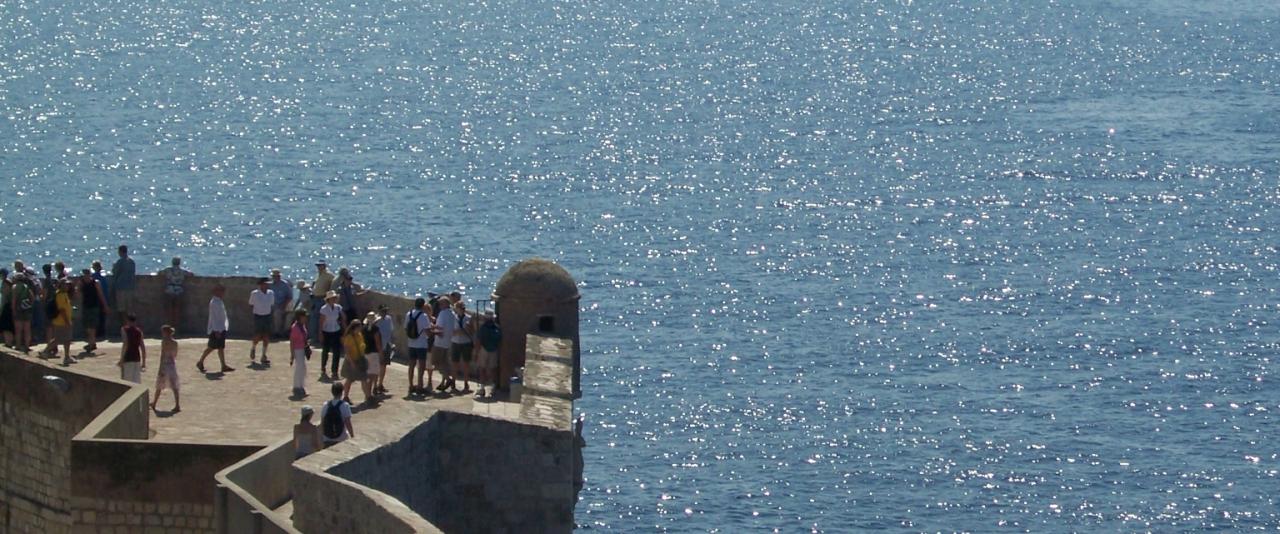
The walls are the main event. The full circuit is about 1.9 km, rising to 25 m high, and you walk it in one direction. There are three entrances: by Pile Gate, by the Ploče Gate in the east, and by Fort St John. Highlights include:
- Minčeta Tower (1460s), the highest point, with the best view over the rooftops.
- Fort Bokar, which guarded the Pile Gate.
- The seaward stretch, with views towards Lokrum.
Allow one and a half to two hours, and carry water: there is very little shade. Tickets are sold by the Society of Friends of Dubrovnik Antiquities at the entrances and on its official webshop. A ticket is valid for one circuit only, with no re-entry. The same ticket also covers Fort Lovrijenac, which stands on its own rock just outside Pile Gate. Check the current price on the official site before you go, because it has risen several times in recent years.
Ending the walk
From Ploče Gate, the lower station of the cable car up Mount Srđ is a short climb away. The top gives a view of the whole Old Town and the islands, and is a good place to be at sunset. On Srđ there is also an exhibition on the 1991–92 siege inside the Napoleonic-era Fort Imperial.
If you have energy left, the Buža bars are worth finding. They sit on the rocks outside the southern walls and are reached through small openings in the wall.