Getting to Know Krk
Krk is one of the two largest islands in the Adriatic, at about 406 square kilometres, roughly level with neighbouring Cres. It is also one of the easiest Croatian islands to reach. The Krk Bridge, opened in 1980, links it to the mainland near Rijeka with a 1,430-metre concrete span, and Rijeka's international airport sits on the island itself, at Omišalj in the north. No ferry is needed, which makes Krk a practical base for a short trip.
About 20,000 people live on the island, in Krk town and in smaller towns such as Malinska, Njivice, Omišalj, Punat, Vrbnik and Baška. The island is mostly karst limestone, and its landscape changes noticeably as you travel from north to south.
Two Landscapes: Green North, Bare South
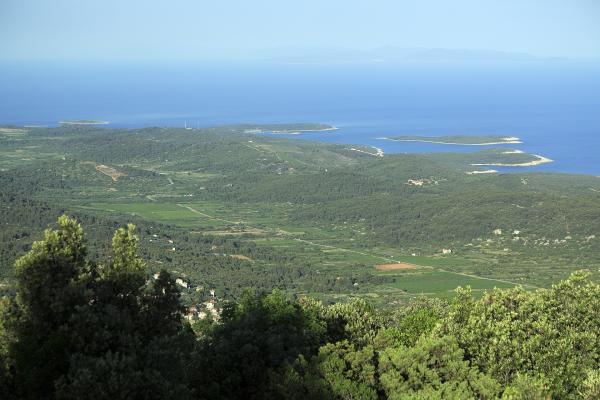
The northern and western parts of Krk are relatively green, with oak woods, Mediterranean scrub, olive groves and small fields enclosed by dry-stone walls. Travel southeast and the land turns barer and rockier. The strong, cold northeasterly wind known as the bora strips vegetation from the exposed slopes, leaving pale limestone ridges with sparse grass and scrub. The highest point, Obzova, reaches 568 metres above Baška.
This contrast is the main reason to explore beyond the beaches. A drive across the island takes less than an hour, but stopping to walk among the stone walls and sheep pastures shows a side of Krk most beach visitors miss.
Vrbnik and Žlahtina Wine
Vrbnik sits on a cliff above the sea on the island's east coast, a compact old town of stone houses and narrow lanes. Its harbour was used for shipbuilding as early as the 13th century. Today it is best known for wine.
The Vrbnik field (Vrbničko polje), a fertile basin of vineyards inland from the town, is the main growing area for Žlahtina, a native Croatian white grape whose name comes from a Slavic word meaning "noble". The wine is pale greenish-yellow, light and fresh with fruity aromas, and it is best served chilled, around 8 to 12 degrees Celsius. It pairs well with local seafood and with Krk's sheep's cheese and cured ham. Several family wineries in and around Vrbnik offer tastings; in the off-season, call ahead.
The vineyards themselves make a pleasant short walk or cycle from the town, with views back to the coast and across to the mainland mountains.
Baška, the Baška Tablet and the Bare Plateau
Baška lies at the southern end of the island in a wide bay backed by bare mountains. It has one of Krk's longest pebble beaches and is the island's main hiking base. Marked trails climb from the town into the karst above, including the bare upland often called the Moon Plateau (Mjesečev plato). These routes have little or no shade and no water, so start early, carry plenty to drink and avoid them on days of strong bora.
Near Baška, in the village of Jurandvor, the small Church of St Lucy is where the Baška tablet was found in 1851. Carved around 1100 in Glagolitic script, it is one of the most important early texts in the Croatian language and contains the earliest known mention of the Croatian king Zvonimir in Croatian. The original has been kept in Zagreb since 1934, and a replica is displayed in the church where it was found.
Krk Town and Košljun
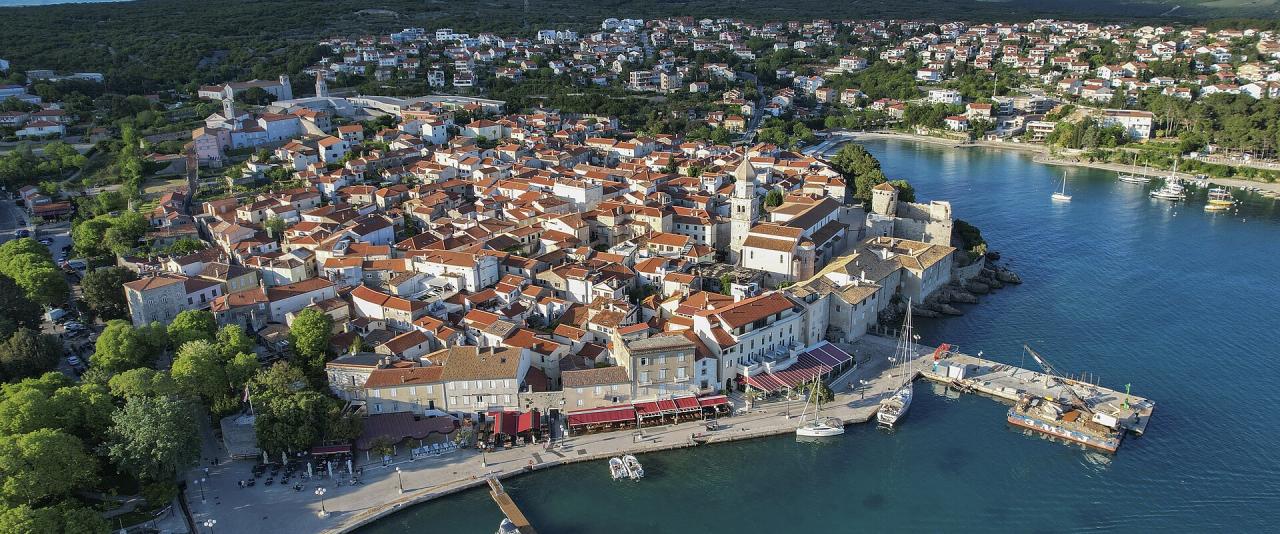
Krk town, the island's largest settlement, has a walled old centre, a cathedral and a waterfront. The island's medieval rulers, the Frankopans, were among Croatia's most powerful noble families, and traces of their era survive in the town's fortifications.
Off Punat, in a sheltered bay, the small wooded islet of Košljun is home to a Franciscan monastery. Boats cross from Punat's waterfront during the season, and the islet is easy to visit in a couple of hours.
Practical Tips
Krk is busiest in July and August, when traffic on the bridge and island roads can be heavy at weekends. For walking and vineyard visits, May, June, September and early October are better: the weather is milder and wineries are less rushed. The bora can blow hard in any season, particularly in winter, and it occasionally closes the bridge to some vehicles, so check conditions before travelling in strong wind.
A car is the easiest way to get around, although buses connect the main towns with Rijeka. Croatia uses the euro, and card payment is widely accepted, though small family producers may prefer cash.