Why Head Inland
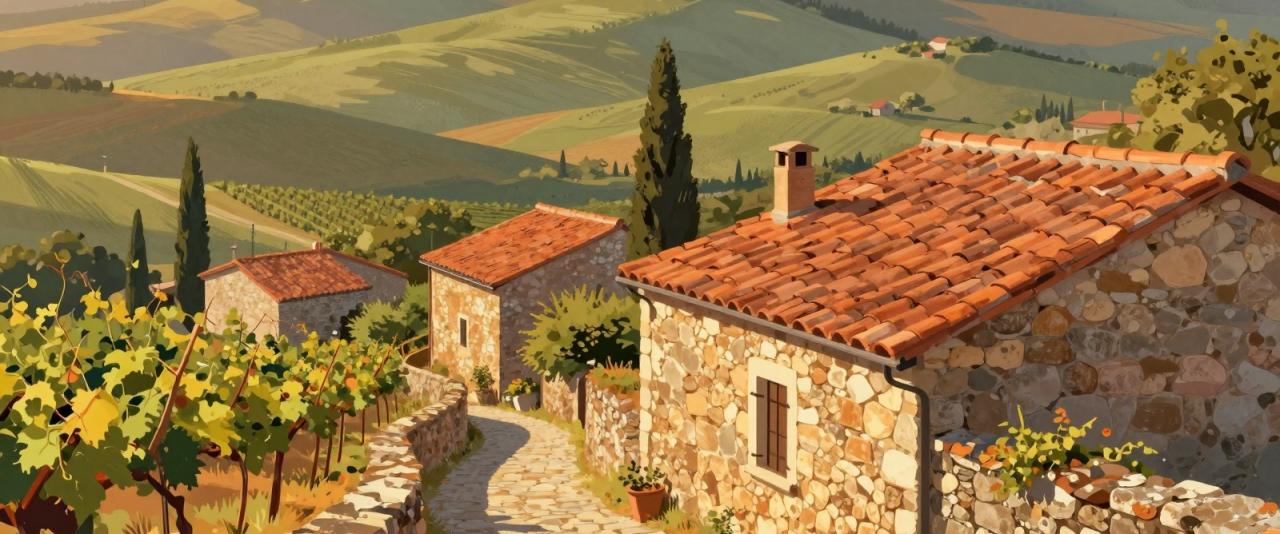
Most visitors to Istria stay on the coast in Poreč, Rovinj or Pula. Drive 30 to 45 minutes inland and the landscape changes completely: green hills, oak forests, vineyards and olive groves, with small walled towns perched on the hilltops. Many of these towns were fortified under Venetian rule, and the oldest street plans follow the shape of the hills. They are small, so you can see several in a day, but they reward a slower pace with a night or two inland.
You need a car. Public transport between the hill towns is sparse, and the most interesting roads are minor ones. Distances are short, but roads are winding and narrow.
Motovun
Motovun is the best known of the hill towns, sitting on a hill about 270 metres high above the Mirna river valley. Its medieval walls survive intact, and you can walk along them for wide views over the valley and the surrounding countryside. The town is tiny: the 2021 census counted fewer than 400 people in Motovun itself.
The forest in the Mirna valley below is one of the main truffle grounds in Istria, known for both black and white truffles, which are found with trained dogs. Since 1999 Motovun has hosted the Motovun Film Festival, a summer festival of independent film, when the town fills with visitors and accommodation is scarce. Car parks sit at the foot of the old town; the walk up is steep but short.
Grožnjan, Oprtalj and Završje
Grožnjan, northwest of Motovun, is known as the "town of artists". Its small old core holds around 20 galleries and studios, and since 1969 it has been a base for the International Cultural Centre of Croatian Musical Youth, which runs music courses and concerts mostly in summer. Grožnjan has a large Italian-speaking community, and Italian is co-official here with Croatian.
Nearby Oprtalj and Završje are quieter hill villages with loggias, churches and views over the Mirna valley. Further south, the hamlet of Draguć is worth a short stop for its small churches with medieval frescoes.
The Parenzana Trail
The Parenzana was a narrow-gauge railway that ran 123 km from Trieste to Poreč between 1902 and 1935, passing below or through Livade, Motovun, Grožnjan, Oprtalj, Završje and Vižinada. Its old trackbed is now a walking and cycling trail across Italy, Slovenia and Croatia, with old tunnels and viaducts along the way. The gentle gradients that suited small steam trains make it comfortable for leisure cyclists. On the Croatian side, the stretches between Vižinada and Motovun and between Livade and Grožnjan are among the most used. Some sections are gravel and a few are rough or overgrown, so a trekking or gravel bike is better than a road bike.
Buzet, Roč and Hum
In the north of inland Istria, Buzet is a larger hill town and a centre of the truffle trade, with shops and restaurants built around truffles. Southeast of Buzet, the road between Roč and Hum is lined by the Glagolitic Alley: eleven outdoor monuments placed between 1977 and 1985 along about 7 km, celebrating the Glagolitic script, the old Slavic alphabet that was used in Istria for centuries.
Roč is a small walled village with a Glagolitic heritage of its own. Hum, at the end of the alley, is often described as one of the smallest towns in the world, with just 52 residents in the 2021 census. It has its walls, a town gate, a parish church and a small museum with Glagolitic inscriptions. Hum is also associated with biska, a local mistletoe-flavoured brandy.
Truffles, Food and Wine
Inland Istria's food is built on truffles, olive oil, cured ham (pršut), pasta such as fuži and pljukanci, and local wines, chiefly white Malvazija and red Teran. White truffles are mainly an autumn product, and the autumn months are when truffle-themed events and menus are most common. Black truffles are available over a longer season. Many family farms and wineries in the area offer tastings; book ahead outside the main summer months, when opening is less regular.
Planning Your Visit
A sensible one-day loop from the coast is Motovun, Grožnjan and Oprtalj; a second day covers Buzet, Roč, the Glagolitic Alley and Hum. Spring and autumn are the best seasons: the hills are green, temperatures suit walking and cycling, and autumn brings the truffle season. In July and August, Motovun and Grožnjan get busy around midday, while the smaller villages stay quiet.
Town cores are mostly pedestrian, with car parks at the edge. Restaurants and shops in the smallest villages may close outside the season, so check before driving out for a specific meal. Croatia uses the euro; cards are widely accepted, but carry some cash for small farms and village shops.