Why Vis Feels Different
Vis is one of the most distant inhabited Dalmatian islands from the mainland, lying southwest of Split beyond Brač and Hvar. Its relative quiet is not an accident. For most of the second half of the 20th century, Vis was a Yugoslav military base, and it remained closed to foreign visitors until 1989. While islands closer to the coast built hotels and marinas, Vis kept its small towns, terraced vineyards and undeveloped coves.
That history still shapes the island. There are few large hotels, most accommodation is in private apartments and small guesthouses, and development has been modest. Vis has become better known in recent years, and parts of the 2018 film Mamma Mia! Here We Go Again were shot here, so do not expect to have it to yourself in August. Outside high summer, though, it is one of the calmer islands to visit.
Getting There
Vis is reached from Split. The car ferry takes about 2 hours 20 minutes, and a high-speed catamaran, which calls at Hvar and Milna on Brač on some sailings, takes around an hour and a half. Both arrive in Vis town. Services are more frequent in summer and limited in winter, and car places on the ferry can sell out on summer weekends, so book or arrive early.
The island is small, about 90 square kilometres, and Vis town and Komiža are linked by a road across the interior. A bus runs between them, but a car, scooter or e-bike makes it much easier to reach the beaches and hilltop viewpoints.
Vis Town and Komiža
Vis town, on the northeast coast, stretches around a deep bay. Its history goes back to Issa, a Greek colony founded in the 4th century BC, and it later became a strategic naval base: British ships under William Hoste defeated a French squadron off the island in 1811, and an Austrian fleet defeated the Italian navy here in 1866 in the Battle of Lissa. The local archaeological collection displays finds from the Greek and Roman periods, and the British-era and Austrian fortifications are visible around the bay.
Komiža, on the west coast, is a fishing town below Hum, the island's highest peak at 587 metres. Komiža fishermen developed the falkuša, a distinctive wooden sailing boat used from the 16th century until the second half of the 20th, and the town's fishing museum explains that tradition. Komiža is also the main departure point for boats to Biševo.
The Blue Cave and Biševo
The small island of Biševo, southwest of Komiža, is home to the Blue Cave, a sea cave on its eastern side. Sunlight enters through an underwater opening and reflects off the white seabed, filling the cave with blue light. In summer the effect is strongest roughly between 10 am and 1 pm. The cave's entrance is only about 1.5 metres high, so visits are by small boat and can be cancelled when the sea is rough. Expect queues in peak season; going early or late in the season helps.
Coves, Beaches and Military Sites
Vis has many small coves rather than long beaches. Stiniva, on the south coast, is the best known: a pebble cove almost enclosed by high cliffs, reached by a steep path from the road or by boat. Srebrna, Stončica and Zaglava are other bays worth seeking out. Bring water shoes, shade and food, as facilities at smaller coves are basic or absent.
The island's military past has become an attraction in itself. Tunnels, former bunkers and a submarine shelter cut into the coast can be visited, usually on guided tours by jeep or boat. Inland, on the slopes of Hum, is the cave used by Tito as a wartime headquarters in 1944.
Vis is part of a UNESCO Global Geopark, recognised in 2019 for the geology of the Vis archipelago, which include volcanic rocks that are unusual among the Adriatic islands.
Wine and Food
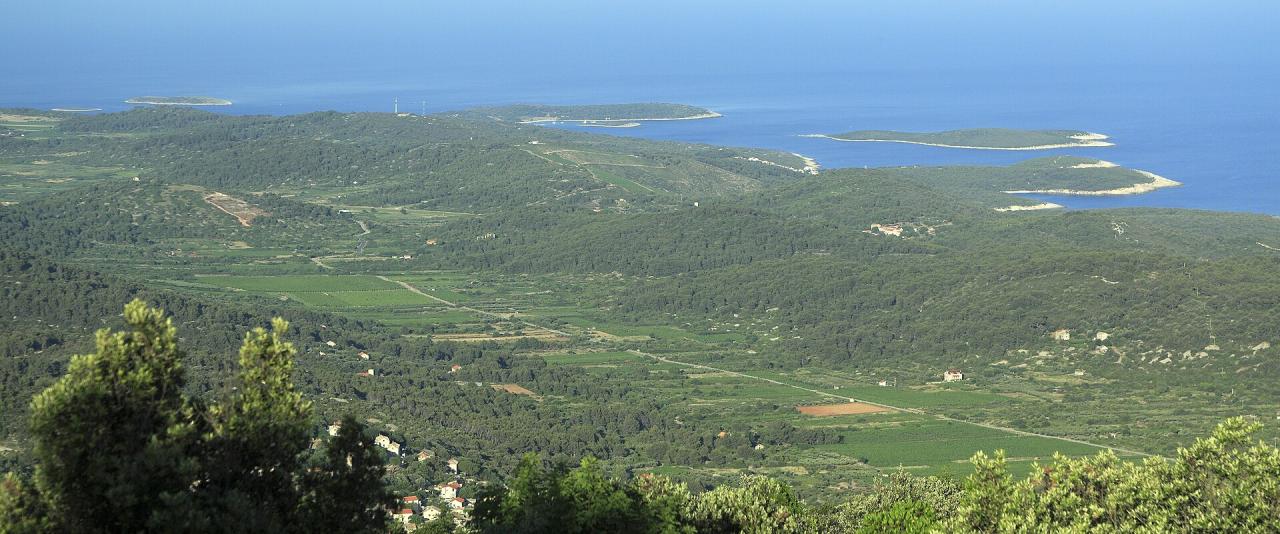
The interior of Vis is farmland and vineyards. The island is known for two local wines: Vugava, a white, and Plavac Mali, a red grown across central Dalmatia. Komiška pogača, a flatbread filled with salted fish, onion and tomato, is the speciality most associated with the island.
When to Go
June and September are the best balance: warm sea, open restaurants and fewer visitors than July and August. In spring and late autumn many businesses close and ferry connections thin out. Croatia uses the euro; card payment is common in towns, but carry cash for small beach bars and boat transfers.