Why Rovinj Gets Compared to Venice
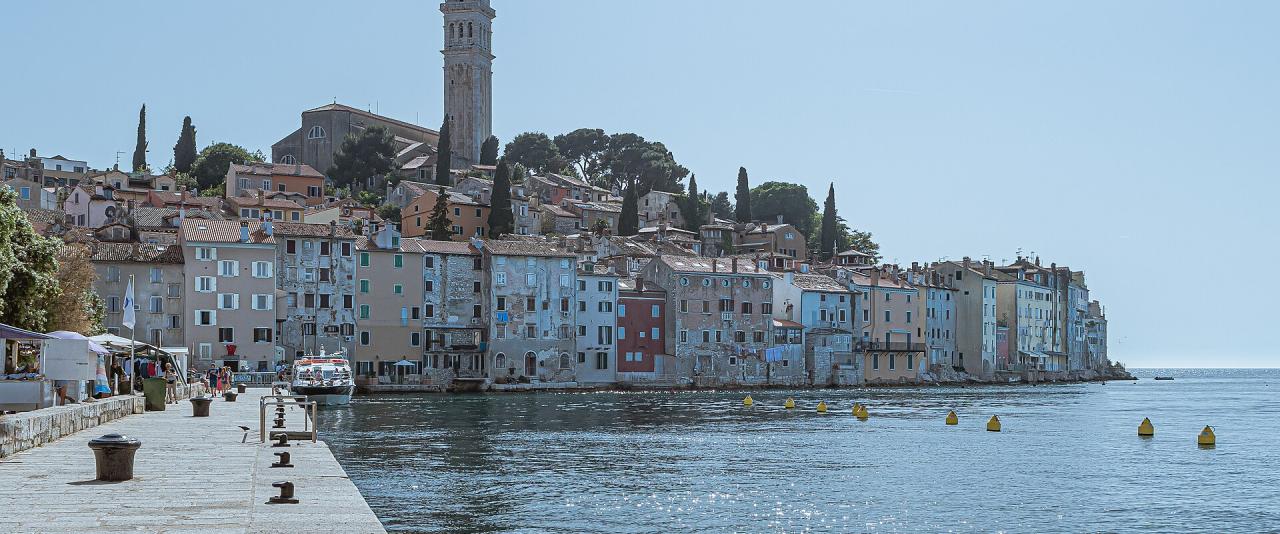
Rovinj (Rovigno in Italian) sits on the west coast of Istria, and the nickname "Venice of Istria" is more than marketing. The town was under Venetian rule for centuries, and it shows: tightly packed houses rise straight out of the sea, narrow lanes climb to a hilltop church, and the bell tower is a near copy of the campanile of St Mark's in Venice. The town is officially bilingual, Croatian and Italian, and you will see both languages on street signs. A small number of residents still speak Istriot, an old Romance language of this coast.
The old town was originally an island. The channel separating it from the mainland was filled in only in 1763, which explains its compact, almost circular shape. Expect stone steps, uneven paving and no cars inside the historic core, so comfortable shoes matter more than anything else you pack.
St Euphemia's Church and the Bell Tower
The Church of St Euphemia crowns the hill at the centre of the old town. The present Baroque building dates from 1725 to 1736, and its facade was added in 1883. The bell tower is older, built between 1654 and 1680, and stands about 60 metres tall. A statue of St Euphemia on top turns with the wind and works as a weather vane.
Inside, a sixth-century Roman sarcophagus holds the saint's relics. Local legend says the sarcophagus washed ashore after a storm and that oxen hauled it up the hill, which is why the hill bears her name. The tower can normally be climbed by a steep wooden staircase in the warmer months for a small fee; the climb is narrow and not suitable for anyone uneasy with heights. From the top you see the whole old town, the harbour and the islands offshore.
Walking the Old Town
Enter the old town through Balbi's Arch, a gate from 1680 near the main square and harbour, with a clock tower close by. From there, lanes lead uphill. Grisia, the steep street running towards the church, is lined with small galleries and studios and is the town's best-known artists' street. Keep walking past the church and down the seaward side, where houses back directly onto the water and small terraces look west over the sea, a good spot at sunset.
The whole peninsula can be walked in under an hour, but the pleasure is in wandering slowly. Mornings are quieter; by midday in July and August the main lanes fill with day visitors.
Batana House and Rovinj's Fishing Heritage
The batana is a flat-bottomed wooden boat that Rovinj fishermen used for generations. Batana House (Kuća o batani / Casa della batana), on the harbour front, is a community ecomuseum about the boat and the people who built and sailed it. UNESCO has recognised the project as a model of good practice for safeguarding living cultural heritage. It is a small museum and a good counterweight to the purely scenic side of the town: you learn how the harbour actually worked before tourism.
Golden Cape Forest Park and Swimming
South of the town, Golden Cape (Zlatni rt) is a protected forest park of pines, holm oaks and cypresses, laid out in the late 19th century. A flat seafront path runs from the marina along the shore, and rocky coves and pebble beaches line the way. This is where most people swim. There are few sandy beaches here, so water shoes help on rocks. The path is also popular for cycling and jogging, and shade under the pines makes it usable even in summer heat.
Islands and Day Trips
The Rovinj archipelago counts about 19 islands and islets offshore. Some, such as St Andrew (Sveti Andrija, also called Red Island) and St Catherine (Sveta Katarina), are reached by regular small passenger boats from the harbour in season. Excursion boats also run north to the Lim Channel, a long, narrow inlet with steep wooded sides, often combined with a stop for swimming. Inland, the hilltop towns of central Istria are within an hour's drive.
Getting There and Practical Tips
The nearest commercial airport is Pula, roughly 40 km south; Rijeka and Trieste airports are further away. Most visitors arrive by car or bus; the bus station is at the edge of the old town. The nearest railway station is at Kanfanar, about 15 km inland, and buses are usually the more practical option. In summer, a passenger catamaran links Rovinj with Venice in roughly two and a half hours each way; check current schedules before planning around it.
Parking near the old town is limited and paid in season, so it is easier to leave the car at your accommodation or in a large car park and walk in. Croatia uses the euro, and cards are widely accepted, though small galleries and market stalls may prefer cash. Shoulder months such as May, June and September give you warm weather, swimmable sea and far less crowded lanes than high summer.