Getting your bearings
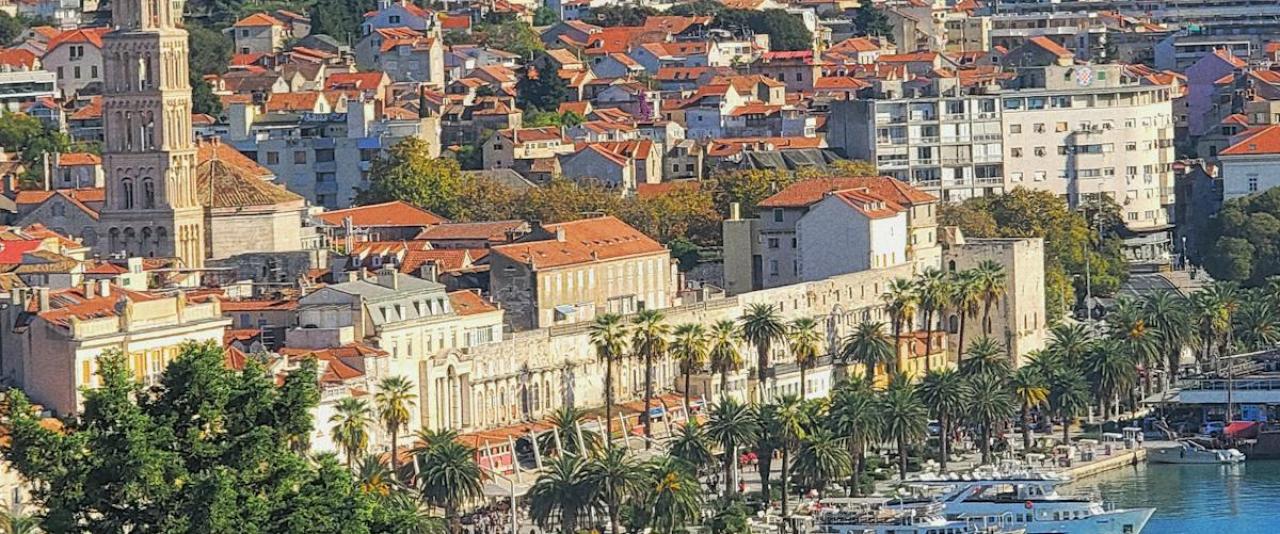
Split is a compact city, and most of what visitors want is within a half-hour walk of the Riva, the palm-lined waterfront in front of Diocletian's Palace. Around that centre are distinct neighbourhoods, each with its own character: the old fishing and farming quarters to the west, the beaches and hillside villas to the east and south, and the newer residential districts beyond. Knowing which is which helps you decide where to stay and how to spend your time.
Grad and the Riva
Grad, the historic core, is the area inside and immediately around the walls of Diocletian's Palace, built at the turn of the 4th century. It is one of the few places in the world where people still live inside a Roman imperial palace, with apartments, shops, bars and churches built into the ancient walls.
The Peristyle, the colonnaded central square, and the Cathedral of St Domnius are the main sights, along with the vaulted substructures under the palace. Just west of the palace walls, the medieval town grew around People's Square (Narodni trg), known locally as Pjaca, and Fruit Square (Voćni trg). It is atmospheric and central but busy and loud in summer, so light sleepers may prefer to stay nearby rather than inside the walls.
The Riva is the city's living room: a wide promenade where people take their morning coffee and evening walk. At its eastern end, just outside the palace's Silver Gate, is the Pazar green market, open every morning, with fruit, vegetables, cheese, dried figs and lavender. On the western side of the centre, the Ribarnica fish market on Marmontova Street sells the morning's catch; it is busiest early in the day.
Varoš: the old western quarter
West of the centre, on the lower slopes of Marjan hill, Varoš (Veli Varoš) is one of the most charming parts of Split. It was historically the quarter of farmers and fishermen, and it still feels like a village: narrow stone lanes, steps, small houses with green shutters and the Church of St Nicholas. Several konobas and small restaurants are tucked into its streets, and it is a quieter place to stay than the palace while still being a few minutes' walk from the Riva.
Marjan forest park
Above Varoš rises Marjan, a wooded hill covering most of the peninsula west of the city. Steps from Varoš lead up to the Vidilica café and viewpoint, and from there paths continue to the summit, Telegrin, and to small medieval chapels and hermitages built into the cliffs. The coastal road and paths around Marjan lead to beaches such as Kašjuni, Bene and Prva Vala. It is a great place for a morning walk, run or bike ride.
Bačvice, Firule and Žnjan
East of the centre, a five-minute walk past the bus and ferry stations, Bačvice is Split's best-known city beach: shallow and sandy, the home of the local game picigin, and lined with cafés and bars that become a nightlife hub after dark. Continue along the coast to Ovčice, Firule and Trstenik for smaller, more local beaches and seafront bars. These neighbourhoods are a good base if you want to swim every day and still walk into town.
Further east, Žnjan is a modern residential area with Split's longest beach, a long pebble strip backed by a promenade, bars, sports courts and food stands. It is less attractive architecturally, but it has space, apartments at lower prices and a local, everyday feel. Buses connect it with the centre.
Meje and Sustipan
South-west of the centre, Meje is a residential area of villas and gardens on the southern slope of Marjan. The Meštrović Gallery, in the summer villa that sculptor Ivan Meštrović built for himself in the 1930s, is here, along with the Kaštilac, a former summer residence containing his series of wooden reliefs of the life of Christ. Closer to the harbour, Sustipan is a small park on a headland that was once a cemetery; it has benches, pines and one of the best sunset views in the city.
Choosing where to stay
For a short first visit, staying in or near the palace puts everything on your doorstep. Varoš is the best balance of character and quiet. Bačvice and Firule suit beach lovers, while Meje is good for a calm stay with views. Žnjan works for families and longer stays on a budget. Wherever you stay, much of Split is hilly or stepped, so pack comfortable shoes.