What the Upper Town is
Zagreb's historic core grew from two medieval settlements on neighbouring hills: Gradec, the royal free town, and Kaptol, the seat of the bishop and the cathedral. Today the area of Gradec is what most people mean by Gornji Grad, the Upper Town. It is a small, quiet district of cobbled streets, baroque palaces, government buildings and museums, sitting directly above the busy Lower Town and Ban Jelačić Square.
You can walk around it in an hour, but it is worth half a day if you stop at a museum or two. Most of the streets are pedestrianised or carry very little traffic, which makes it pleasant for families, although the cobbles and slopes are hard work with a stroller.
Getting up there
The classic way up is the funicular (uspinjača) from Tomićeva Street, just off Ilica, a few minutes' walk from Ban Jelačić Square. Opened in 1890, it climbs about 66 metres of track, making it one of the shortest public funiculars in the world, and the ride takes under a minute. It is part of the city transport network and runs frequently throughout the day.
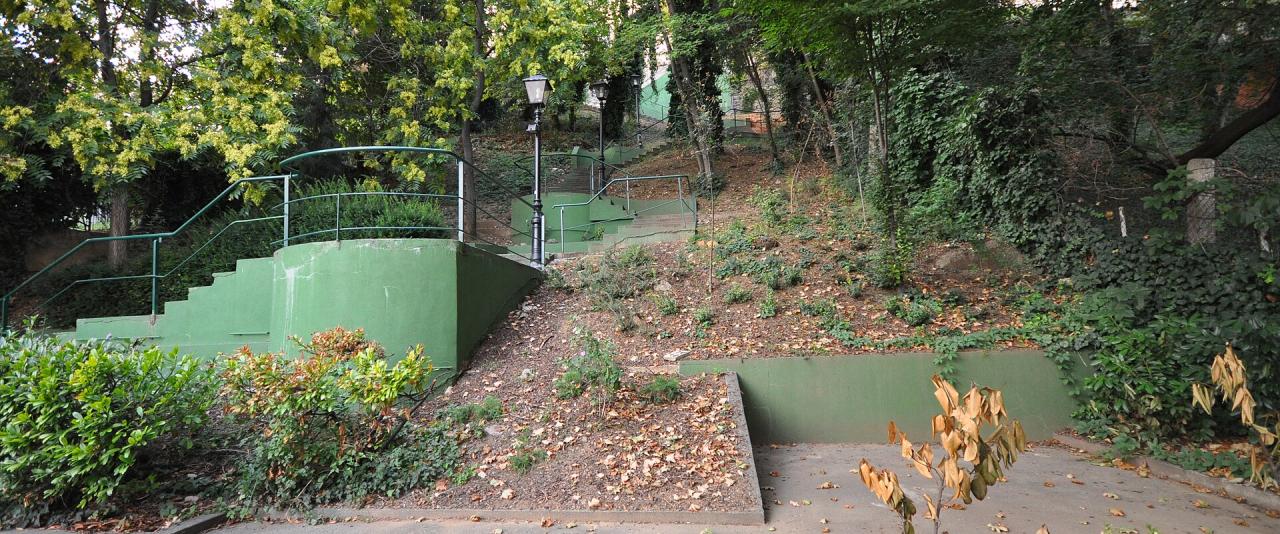
If you prefer to walk, there are steps up from Tomićeva next to the funicular, a path from the Dolac market area via Krvavi most and Radićeva Street, and the route through the Stone Gate.
Strossmayer Promenade and Lotrščak Tower
At the top of the funicular you arrive on the Strossmayer Promenade (Strossmayerovo šetalište), a tree-lined walk along the old town wall with one of the best views over the rooftops of the Lower Town. In summer it hosts evening events and pop-up bars.
Beside it stands Lotrščak Tower, a 13th-century defensive tower. Every day at noon a cannon is fired from the tower, a tradition that dates back to 1877. It is loud, short and a reliable hit with children; stand on the promenade a few minutes before twelve to see the puff of smoke.
St Mark's Square
A short walk north brings you to St Mark's Square (Markov trg), the political heart of Croatia. On one side is the Croatian Parliament (Sabor), on the other Banski dvori, the seat of the government. In the middle is St Mark's Church, recognisable by its tiled roof showing two coats of arms: the medieval arms of the Kingdom of Croatia, Dalmatia and Slavonia on one side and the coat of arms of the City of Zagreb on the other.
The church was badly damaged in the 2020 earthquakes and reopened to worshippers in December 2023 after a three-year reconstruction. Access to the square itself is sometimes restricted for security or official events, so you may find parts of it fenced off.
The Stone Gate and the museums
Walk down Kamenita Street to the Stone Gate (Kamenita vrata), the only one of Gradec's original town gates that still stands. Inside its dark passage is a shrine with a painting of the Virgin Mary, which according to tradition survived a great fire in 1731 untouched. People stop to light candles and pray here at all hours, so visit quietly.
Several museums are clustered on Ćirilometodska and the surrounding streets. The Museum of Broken Relationships, made up of objects donated by people after the end of a relationship, is the best known and is open daily. The Zagreb City Museum on Opatička Street occupies a former convent complex and covers the city's history. Some institutions in this part of town were closed for years after the 2020 earthquakes and have been reopening in stages, so check individual websites for current hours.
Views, gas lamps and coming down
Beyond the main sights, the pleasure of Gornji Grad is simply walking: Ćirilometodska, Demetrova, Opatička and the quiet lanes behind them have elegant facades and few people. The Jesuit Square (Jezuitski trg) is home to the Klovićevi dvori gallery, which hosts major temporary exhibitions.
At dusk, look out for the gas street lamps. The Upper Town still has well over a hundred gas lamps, and lamplighters light and extinguish them by hand each day, a tradition the city has kept going.
To come down, take the funicular back to Ilica, or walk through the Stone Gate and down Radićeva to Tkalčićeva Street, Zagreb's busiest café and bar street, which follows the line of the old stream that once separated Gradec from Kaptol. From there it is a short walk to Dolac market and the cathedral on Kaptol.