
The Rijeka Carnival (Riječki karneval) 2027 runs from 17 January to 10 February 2027, and its high point, the International Carnival Parade, is on Sunday 7 February 2027 along the Korzo, Rijeka's main promenade. The Children's Carnival Parade is on Saturday 30 January and the Carnival Queen Pageant on Friday 22 January. Watching the parades from the street is free. In 2026 the big parade started at noon, and more than 11,000 people in 100 masked groups took part.
Rijeka calls the carnival its "fifth season": a month when the city is taken over by masked groups, parties and neighbourhood events. This guide covers the main dates, the two parades, the bell-ringers (zvončari) whose tradition is on UNESCO's intangible heritage list, where to watch, and how to get there.
 The Korzo seen from above during the International Carnival Parade, February 2018. Image: Antonio199cro, CC BY-SA 4.0, via Wikimedia Commons.
Rijeka Carnival 2027: the key dates
The Rijeka Tourist Board, which organises the carnival, has published these dates for 2027:
- Carnival season: 17 January to 10 February 2027 (Ash Wednesday).
- Rijeka Carnival Queen Pageant: Friday 22 January 2027.
- Children's Carnival Parade: Saturday 30 January 2027, on the Korzo.
- International Carnival Parade: Sunday 7 February 2027, on the Korzo.
The full 2027 programme, with times and venues for each event, isn't out yet. The Tourist Board took proposals for the official programme until 25 September 2026 and will publish the full programme on visitrijeka.hr. As a guide, the 2026 timetable is below.
The carnival always starts on 17 January, the feast of St Anthony, known locally as Antonja. Its end depends on the date of Easter, which is why the season is short in 2027 and much longer in 2028, when the International Parade falls on 27 February.
How the carnival opens: flags, keys and the Pust
The opening day follows the same pattern each year. In 2026, on 17 January:
- a Parade of Carnival Flags gathered at 10:30;
- the programme on Jelačićev trg started at 11:15, followed at around noon by the handover of the Key of the City at the City Hall, which hands the city over to the carnival for the season;
- in the evening, from 6 p.m., the Pust (the carnival figure) was raised in the neighbourhoods of Pehlin, Pašac and Zamet as part of the Antonja celebrations.
Expect a similar opening on Sunday 17 January 2027.
The Carnival Queen Pageant
The Queen Pageant is traditionally the first big show of the season. Masked groups put forward candidates, who compete for the "Golden Cloak" with charm, wit, dancing and music; the organisers say that beauty is not an advantage. The groups that accompany each candidate also compete for the best stage performance, and a party follows the crowning. The Queen then represents the carnival at its public events. The 2027 pageant is on Friday 22 January; in 2026 it was held at the Dvorana mladosti sports hall at 8 p.m.
The Children's Carnival Parade
A week before the big parade, the Children's Carnival Parade fills the Korzo with masked children from Croatia and abroad: fairy-tale characters, animals and inventions of every kind, some pushed in strollers by their kindergarten teachers and parents. The Tourist Board says it draws tens of thousands of spectators. In 2027 it's on Saturday 30 January; in 2026 it started at noon.
This is the parade to choose if you're travelling with young children: it's all about the kids, and it's a gentler introduction to the carnival than the big Sunday parade.
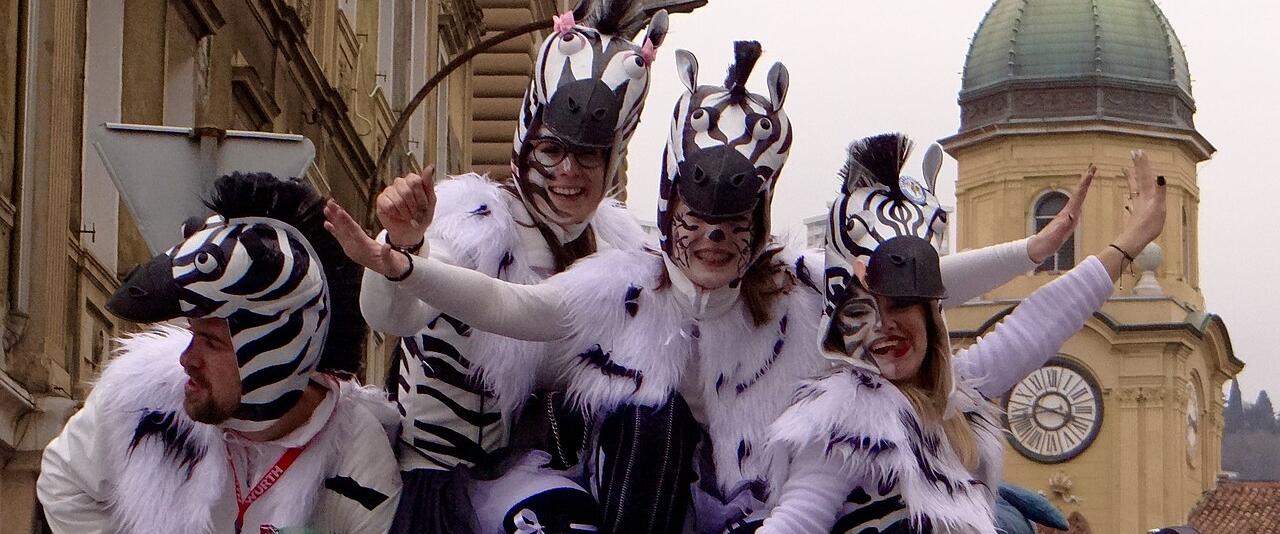
 A masked group on its float in the International Carnival Parade, February 2010. Image: Roberta F., CC BY-SA 3.0, via Wikimedia Commons.
The International Carnival Parade
The International Carnival Parade is the climax of the season. In 2026, the 43rd parade brought more than 11,000 masked participants in 100 groups, with more than sixty floats, along the Korzo. Groups came from Croatia and from Italy, Hungary, Slovenia, Serbia, Montenegro and North Macedonia. The biggest single group had 800 members.
Most of the groups are citizens' associations from Rijeka and the surrounding towns and villages, and many use their masks to comment on the year's news and politics. Others pick a theme for the day: in 2026 there were Mexicans, Vikings, chimney sweeps, Alice in Wonderland and 101 Dalmatians. Groups compete for creativity, humour and originality.
The modern parade began in 1982, when the Tourist Board invited three masked groups to walk down the Korzo: Lako ćemo, the Pehinarski feštari and the Halubajski zvončari, the bell-ringers from Halubje. Masking in Rijeka is much older. A city council decree of 1449 banned covering the face with a mask (except at masked dances in the castle), and the Tourist Board points to it as proof of how old the custom is.
2027 date: Sunday 7 February. Start time: noon in 2026; check the 2027 programme. If you can't be there, the Tourist Board streamed the 2026 parade live on its website.
 A masked group dances along the Korzo during the International Carnival Parade, February 2010. Image: Roberta F., CC BY-SA 3.0, via Wikimedia Commons.
Zvončari: the bell-ringers
The parade traditionally ends with the zvončari, the bell-ringers who keep the carnival customs of the Croatian Littoral alive. In 2026 the last groups to pass were the Zametski zvončari, the Grobnički dondolaši and the Halubajski zvončari, and their ringing marked the end of the parade and the carnival season.
The bell-ringers wear sheepskins with large bells tied around their waists and hats decorated with sprigs of evergreen, and many groups also wear tall masks. The bells ring with every step. In 2009 UNESCO added the "Annual carnival bell ringers' pageant from the Kastav area" to its Representative List of the Intangible Cultural Heritage of Humanity. UNESCO describes the January procession through the villages of the Kastav area, just outside Rijeka, as a way of strengthening bonds within the community and between neighbouring towns.
The Zametski zvončari, from Rijeka's Zamet neighbourhood, were formally founded in 1968, although bell-ringers had been turning out there since the 1960s.
 Halubajski zvončari in sheepskins and masks at the Rijeka Carnival, February 2010. Image: Roberta F., CC BY-SA 3.0, via Wikimedia Commons.
 The Halubajski zvončari in Kastav, the hill town above Rijeka. Image: Vjekoslav Frlan. This image is copyright protected and it's unauthorized use is , CC BY-SA 4.0, via Wikimedia Commons.
Where to watch the parades
Both parades pass along the Korzo, the pedestrian street through the centre of Rijeka. Some tips:
- Arrive early to get a place along the barriers before the parade starts.
- Look for a step or a raised spot. The parade passes at street level, so a few steps up helps if you're not in the front row.
- Stay for the end. The zvončari close the parade.
- Stay in town afterwards. On parade day in 2026 there was a free Karneval na Gatu party on Adamićev gat from 10 a.m., a free Masquerade Open Air party on Titov trg from 2 p.m., and concerts in the evening.
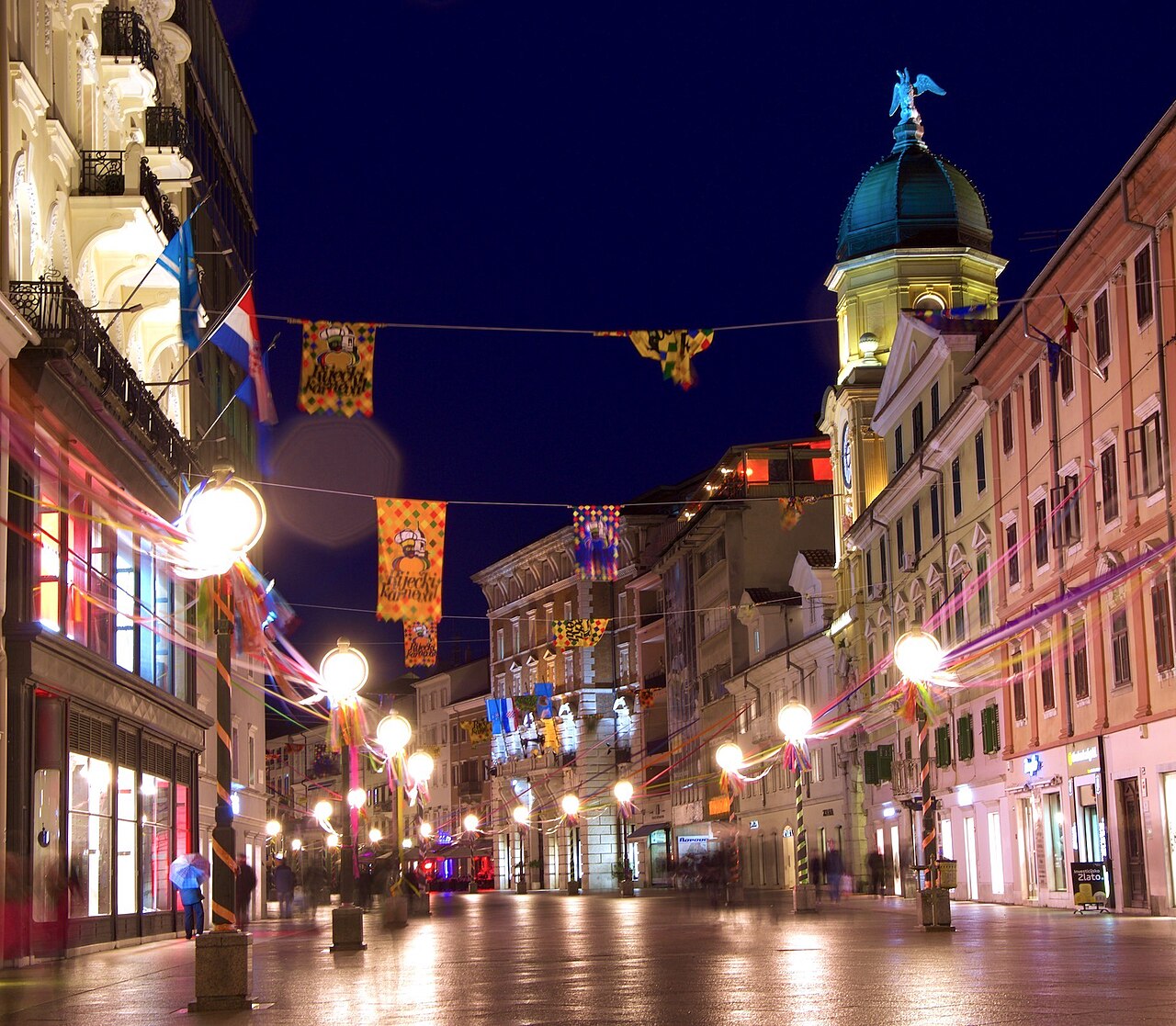 The Korzo and the City Clock Tower at night, hung with carnival decorations, February 2018. Image: Antonio199cro, CC BY-SA 4.0, via Wikimedia Commons.
Other events during the carnival
The programme grows every year. In 2026 it included the Carnival Run on the Molo Longo breakwater, a Carnival Snowboard Session on Platak, the "Days of Laughter" comedy evenings at the Croatian Cultural Centre in Sušak, children's masked balls in the neighbourhoods, a crinoline night aboard the Botel Marina, and charity events where groups serve carnival stews in the city centre. The neighbourhood Riječki karnevalski kantun events, such as masked dances in Pašac and Zamet, show the carnival as locals live it.
Many of these events have their own tickets and times; check the official programme on visitrijeka.hr once it's published.
Getting to Rijeka for the carnival
- By car: Rijeka is on the A6 motorway from Zagreb and is linked by motorway to Istria and the Adriatic coast. On parade days, plan to park outside the centre and walk in.
- By train or bus: Rijeka has rail and coach connections with Zagreb, and both the railway station and the main bus station are in the city centre.
- By air: Rijeka Airport is on the island of Krk, across the bridge from the mainland. Zagreb, Pula and Trieste airports are other options, followed by a drive or coach.
Book accommodation early for the parade weekend. Nearby Opatija, on the coast west of Rijeka, is another base.
Tips for the carnival
- Dress up. The carnival motto is "Be whatever you want", and spectators in masks and costumes are part of the scene.
- Dress for winter too. Early February on the Kvarner coast can be cold and windy. Wear layers under your costume.
- Keep an eye on the weather. The parade usually goes ahead in poor weather, but a heavy bura (the cold north wind) or rain can make a long wait uncomfortable.
- Learn the greeting. Rijeka's carnival motto is "Krepat, me ne molat!", which the Tourist Board translates as "Rather die than surrender!".
If the weather turns
If rain or bura hits on parade day, the shops and cafés along the Korzo and the covered passages around it are your shelter. For a day indoors, Rijeka has the City Museum and the Maritime and History Museum near the centre, and the 2026 programme ran exhibitions about the carnival on the Korzo both before and after the season.
When to go
To see the most in one trip, come for the last weekend: Saturday 6 and Sunday 7 February 2027, with the International Parade on the Sunday. With young children, the Children's Parade on Saturday 30 January is the easier choice. If you'd like to see the zvončari in their own villages, ask at the Rijeka Tourist Board about the January processions in the Kastav area.