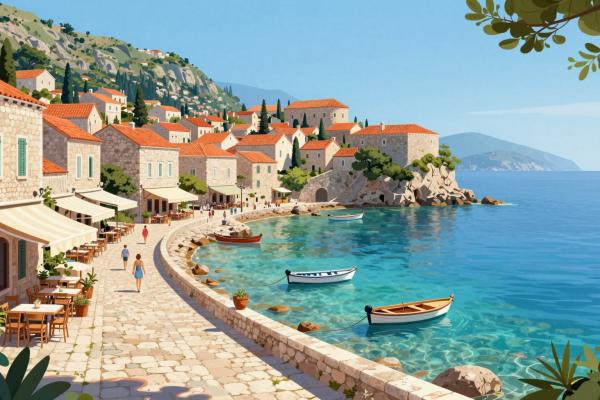
Two weeks is enough to see the Croatia most first-time visitors come for, if you accept one rule: fewer stops, longer stays. This route runs from the capital to the Adriatic's far southern end in a single loop with no backtracking. It starts in Zagreb, goes to Plitvice Lakes, follows the coast through Zadar, Šibenik and Krka to Split and Trogir, crosses to the island of Korčula and finishes in Dubrovnik. You fly into Zagreb and out of Dubrovnik, so nothing has to be returned or retraced.
Everything between the cities is by coach, with two short boat legs, so you do not need a car. The longest single transfer is Split to Dubrovnik, about four hours by bus. Most legs are one to three hours. The plan is written for the main season, April to October. Several things stop at the end of October (the Krka boats, the Dubrovnik cable car's long hours, the summer catamarans), so the section "Travelling between November and April" near the end lists what changes. Prices and times below are as published in October 2026.
Book these before you go.
- Flights. Fly into Zagreb and out of Dubrovnik as two one-way tickets or an open-jaw return. Booking this way saves a full day of travel back to Zagreb.
- Plitvice Lakes ticket. Buy online at the park's official ticket shop for the day you go. The ticket is validated at the entrance you choose, you cannot enter before the time on it, and you may arrive up to one hour late. In 2026 the adult day ticket costs EUR 23 from 1 April to 31 May and in October, EUR 10 from November to March, and EUR 40 (before 16:00) in June to September.
- Dubrovnik city walls. Buy at the official shop, shop.citywallsdubrovnik.hr, or at the kiosks at the Pile Gate. Adults pay EUR 40 from 1 March to 30 November, according to local guide sites; the official shop shows the current tariff. The ticket is valid for one circuit with no re-entry.
- Catamarans in July and August (and the Hvar-Dubrovnik line in any peak week). They sell out days ahead. Book Split to Korčula through the operator or Ferryhopper.
- Zagreb to Plitvice and Split to Dubrovnik coaches if you travel in summer or on a Friday or Sunday. Seats are rarely sold out in the shoulder season, but a booking fixes the time.
- Accommodation in Dubrovnik and Korčula Old Town. These fill first in May to September.
The 14 days at a glance
| Day | Base | What you do | Move |
|---|---|---|---|
| 1 | Zagreb | Arrive, Upper Town and Ban Jelačić Square | Airport to centre |
| 2 | Zagreb | Cathedral area, Dolac, Museum of Broken Relationships, Mirogoj | None |
| 3 | Plitvice | Coach to the park, afternoon walk | Coach, about 2.5 h |
| 4 | Zadar | Morning at the lakes, afternoon coach | Coach, about 2 h |
| 5 | Zadar | Roman Forum, old town, sunset | None |
| 6 | Šibenik | Coach, cathedral and old town | Coach, about 1 h |
| 7 | Split | Krka waterfalls, afternoon coach | Coach, about 1.5 to 2 h |
| 8 | Split | Diocletian's Palace, Marjan | None |
| 9 | Split | Day trip to Trogir | Bus, under 1 h each way |
| 10 | Korčula | Catamaran or bus to the island | 2.5 to 5 h |
| 11 | Korčula | Old town, walls, a short boat or walk | None |
| 12 | Dubrovnik | Catamaran or bus, first evening on the Stradun | 2 to 3.5 h |
| 13 | Dubrovnik | City walls, Lovrijenac, cable car | None |
| 14 | Dubrovnik | Morning free, fly out | Airport |
Day 1 - Zagreb: the Upper Town on foot
Fly into Zagreb's Franjo Tuđman Airport and take the airport bus or a taxi to the centre. Plan on about 30 to 40 minutes. A first-night stay near Ban Jelačić Square keeps everything within about 15 minutes' walk.
Croatia is in the euro zone (it adopted the euro on 1 January 2023) and in the Schengen Area (since the same day). The airport has the two lanes you would expect. Non-EU visitors are registered at the border in the EU's Entry/Exit System, which the European Commission says has been fully operational since 10 April 2026. ETIAS, the pre-travel authorisation for visa-exempt visitors, is not yet in operation, and the Commission says no applications are being accepted. It will announce a start date several months ahead, so for a trip in the coming months you need only a passport valid for the stay.
Spend the afternoon in Gornji Grad, the Upper Town. Walk up by the funicular, a line of about 66 metres opened in 1893 that takes roughly a minute, or by the Stone Gate stairs. At the top is the Lotrščak Tower, where a cannon is fired every day at noon, a custom dating from 1877. From there it is a short walk to St Mark's Church with its tiled roof showing the coats of arms of Croatia and Zagreb.
 St Mark's Church in the Upper Town, with the tiled roof of 1880 bearing the arms of Zagreb and Croatia. Image: Fred Romero from Paris, France, CC BY 2.0, via Wikimedia Commons.
Come back down along Tkalčićeva Street in the early evening.
| Time | Stop | Allow | Book ahead? |
|---|---|---|---|
| Afternoon | Funicular, Lotrščak Tower, St Mark's | 2 h | No |
| Early evening | Tkalčićeva Street, Ban Jelačić Square | 1 h | No |
Day 2 - Zagreb: three museums, a market and a cemetery
Start at Dolac market, the open-air produce market above the main square, which is at its best before about 13:00. A few steps away stands the Zagreb Cathedral. It has been under restoration since the 2020 earthquake, and sources disagree on when and how fully the interior reopened, so treat the visit as an exterior view and go in only if the doors are open.
The Museum of Broken Relationships is the city's most unusual museum: a collection of objects donated by people to mark the end of a love affair, each with a short text. The museum lists daily hours of 09:00 to 21:00 in winter and 10:00 to 22:00 in summer. Allow an hour.
In the afternoon take a short tram or taxi ride to Mirogoj Cemetery, a park-like cemetery with arcades and domes designed in the 19th century. Entry is free, and it is quiet and walkable in under an hour. If you would rather stay in the centre, the Upper Town museums (Museum of the City of Zagreb, Croatian Natural History Museum) fill the same time.
| Time | Stop | Allow | Book ahead? |
|---|---|---|---|
| Morning | Dolac, cathedral exterior | 1.5 h | No |
| Late morning | Museum of Broken Relationships | 1 h | No |
| Afternoon | Mirogoj | 1 h | No |
Day 3 - Zagreb to Plitvice: the road to the lakes
Take the 10:30 Arriva coach from Zagreb to Plitvice Lakes, which the operator lists as 2 hours 30 minutes to 2 hours 37 minutes and EUR 15.60. Earlier (05:45) and later (14:15) departures exist on the same timetable. FlixBus also serves the park and reportedly stops in front of Entrance 1. Check the timetable for your date, because the listed schedule carries no validity dates.
You arrive at around 13:00. Leave your bags at the free luggage storage at the entrance, buy your ticket (online is cheaper in time, if not in euros) and take a short walk. The park lists ticket sales until 15:00, so you cannot start a long route at this hour. The best afternoon option is programme A from Entrance 1: 2 to 3 hours, 3.5 km, no boat, a circuit past the Great Waterfall and the Lower Lakes.
Plitvice Lakes National Park has 16 named lakes joined by waterfalls and has been a UNESCO World Heritage Site since 1979. The tallest fall, Veliki Slap, drops about 78 metres. Swimming in the lakes is strictly prohibited, and the park enforces it.
 Veliki Slap, the tallest waterfall in the park, at the end of the Lower Lakes canyon. Image: Antonio Pejić, CC BY-SA 4.0, via Wikimedia Commons.
Sleep near the park. In the cold season most catering inside it is closed, and accommodation inside is limited to Hotel Jezero, so book the night in advance.
| Time | Stop | Allow | Book ahead? |
|---|---|---|---|
| 10:30 | Coach from Zagreb | 2.5 h | Optional |
| 14:00 | Programme A, Entrance 1 | 2 to 3 h | Ticket online |
Day 4 - Plitvice and the coach to Zadar
This is the park's full day. With a ticket validated for 08:00 or 09:00, you have time for programme C (4 to 5 hours, 8 km, boat and panoramic vehicle) or programme H from Entrance 2 (4 to 6 hours, 8.9 km), which walks the whole system. The shorter alternative is programme B (3 to 4 hours) from Entrance 1. The Upper Lakes are the quieter, greener section, so they reward the longer routes. The electric boat across Lake Kozjak and the panoramic vehicle are included in the ticket.
 Lake Kozjak, the largest of the 16 lakes, crossed by the park's electric boat. Image: Falk2, CC BY-SA 4.0, via Wikimedia Commons.
The park reduces its hours from the end of October, so check the closing time before choosing. For the Upper Lakes, note that the park says they are usually closed in winter and reopen in early April.
For the onward journey, take a coach to Zadar from the main road. FlixBus lists about five trips a day at roughly 1 hour 45 minutes, and a local operator also serves it in peak season. Times are not confirmed for this autumn, so check them before you plan the afternoon. Leave the park by about 15:00 to be safe.
| Time | Stop | Allow | Book ahead? |
|---|---|---|---|
| 08:00 | Programme C or H | 4 to 6 h | Yes, online |
| Afternoon | Coach to Zadar | about 2 h | Check times |
Day 5 - Zadar: Roman stones and a sunset
Zadar's old town sits on a peninsula about 500 metres long, and you can see all of it on foot. Begin at the Roman Forum, built between the 1st century BC and the 3rd century AD, beside the 9th-century round church of St Donatus. Two minutes away stands the Church of St Chrysogonus, with its Romanesque apses. The old town's open squares, including Five Wells Square, are free to walk.
 The Roman Forum with the round church of St Donatus and the cathedral bell tower behind it. Image: dronepicr, CC BY 2.0, via Wikimedia Commons.
At the tip of the peninsula, the Sea Organ turns the movement of the sea into low chords through pipes under the marble steps, and the Greeting to the Sun, a disc of solar panels in the paving, glows after dark. Both are the work of the architect Nikola Bašić, finished in 2005 and 2008. Come at sunset and stay for the lights.
If you have energy left in the afternoon, walk the town walls and the Land Gate, or take a short boat tour to the Kornati archipelago (these run mainly in season).
| Time | Stop | Allow | Book ahead? |
|---|---|---|---|
| Morning | Forum, St Donatus, St Chrysogonus | 2 h | No |
| Afternoon | Old town, walls, Five Wells Square | 2 h | No |
| Sunset | Sea Organ, Greeting to the Sun | 1 h | No |
Day 6 - Šibenik: a cathedral built entirely of stone
Take a coach from Zadar to Šibenik (about an hour, a frequent service along the coast). Šibenik's main sight is the Cathedral of St James, built from 1431 to 1535 by Juraj Dalmatinac and Nikola Firentinac, a UNESCO World Heritage Site since 2000. The walls and the barrel vault are built of fitted stone blocks, and a frieze of 71 carved faces runs round the apses.
 The Cathedral of St James, built entirely of stone in the 15th and 16th centuries. Image: Bernard Gagnon, CC BY-SA 4.0, via Wikimedia Commons.
The tourist board lists the cathedral as open daily, though mass times can close it to visitors, and we could not confirm the current admission price, so ask on the spot. Spend the afternoon walking the stepped lanes of the old town up to the fortresses. St Nicholas Fortress, at the mouth of the channel, is reached only by boat excursion, so skip it if you are short of time.
Sleep in Šibenik rather than at Skradin. The Krka park entrance is closer to the town, and the coach to Split leaves from here on Day 7.
| Time | Stop | Allow | Book ahead? |
|---|---|---|---|
| Morning | Coach to Šibenik | 1 h | No |
| Afternoon | Cathedral, old town | 3 h | No |
Day 7 - Krka: waterfalls, then Split
Take the morning bus from Šibenik to Skradin, the small town at the edge of Krka National Park. The Autotransport Šibenik buses to Skradin run year-round according to secondary sources, but we could not confirm a timetable, so confirm it at the station. The park's boat from Skradin to Skradinski Buk runs from 1 April to 31 October and is included in the ticket. A bus from Lozovac, the other entrance, is also included.
In October the full adult ticket is EUR 20, according to the park's published price list (EUR 40 in June to September, EUR 7 from November to March). Individual boat excursions are extra: EUR 15 for the 2-hour trip to the island of Visovac and its monastery, EUR 20 for the 4-hour trip that also reaches the Roški Slap waterfall. These have no fixed schedule and are arranged day by day. The bus to Roški Slap itself only runs from 1 June to 30 September.
 Skradinski Buk, the lowest and largest cascade on the Krka River. Image: Skot, CC BY-SA 4.0, via Wikimedia Commons.
At Skradinski Buk there is a wooden footpath of about 2 km round the falls, and you need around two hours. After lunch, take the boat back to Skradin, walk past the clock tower, and take a coach to Split. Direct coaches from Skradin to Split are reported, though their times are not confirmed, so the safe plan is to return to Šibenik and take the Šibenik-Split coach (about 1.5 to 2 hours).
| Time | Stop | Allow | Book ahead? |
|---|---|---|---|
| 09:00 | Bus to Skradin, boat to the falls | 1 h | No |
| Late morning | Skradinski Buk circuit | 2 h | Online ticket optional |
| Afternoon | Boat to Skradin, coach to Split | 3 h | Check times |
Day 8 - Split: living inside a Roman palace
Diocletian's Palace was built for the Emperor Diocletian between about AD 295 and 305, and it is not a ruin or a museum: people live and work inside the walls. About 215 by 180 metres in size, it holds shops, flats and bars set in the original Roman streets. Begin at the Peristyle, the colonnaded courtyard at its centre.
 The Peristyle, the central court of Diocletian's Palace. Image: Petra-81, CC BY-SA 4.0, via Wikimedia Commons.
On the Peristyle stand the Cathedral of St Domnius, which started life as Diocletian's mausoleum, and its bell tower. Each part sells its own ticket, and we could not confirm the 2026 prices, so check at the door. The climb to the top of the tower is steep. Under the palace, the cellars (Podrumi) are among the best-preserved parts of the Roman building.
In the afternoon walk the Riva, the seafront promenade, then climb the Marjan Hill stairs for a view of the town and the islands. Allow 45 minutes up and back.
| Time | Stop | Allow | Book ahead? |
|---|---|---|---|
| Morning | Peristyle, cathedral, cellars | 3 h | No |
| Afternoon | Riva, Marjan stairs | 2.5 h | No |
Day 9 - Trogir: a small town on an island
Trogir is a walled town on a small island joined by bridges to the mainland, about 30 km west of Split. Buses and local services take under an hour. The old centre is a UNESCO World Heritage Site (since 1997), and it can be walked in a morning.
The main sight is the Cathedral of St Lawrence, with its Romanesque west portal carved by the master Radovan around 1240. Nearby are the Town Loggia and the Kamerlengo Fortress at the western end of the Riva. The cathedral and the fortress each charge an admission fee. we could not confirm the 2026 prices or the autumn hours, so check them locally.
 Trogir seen from above, with the old town on its island. Image: Qypchak, CC BY-SA 4.0, via Wikimedia Commons.
Return to Split for the evening, and pack for the island.
| Time | Stop | Allow | Book ahead? |
|---|---|---|---|
| Morning | Bus to Trogir | under 1 h | No |
| Late morning | Cathedral, loggia, fortress, Riva | 3 h | No |
| Afternoon | Bus back to Split | under 1 h | No |
Day 10 - Split to Korčula: choosing the island
Most first-time itineraries use Hvar. This one uses Korčula, for one practical reason: the onward leg. The Split-Hvar catamaran runs all year (on a reduced winter timetable), but the Hvar-Dubrovnik catamaran runs only in season, roughly May to October, takes about 3 hours 20 minutes and costs about EUR 50. Outside the season you must go back through Split, which wastes a day. Korčula has a land link to Dubrovnik that works all year: a ferry from Dominče to Orebić on the Pelješac peninsula and a coach from there.
Your options for the crossing:
- Catamaran, April to October. The Kapetan Luka (Krilo) coastal line runs Split, Hvar, Korčula, Mljet, Dubrovnik from 1 April to 31 October 2026. The Split to Korčula crossing takes about 2 hours 20 minutes to 3 hours and costs roughly EUR 20 to 30.
- Catamaran plus bus. A catamaran to Vela Luka on the island's west end takes about 2 hours 10 minutes, followed by a coach of about an hour to Korčula Town. we could not confirm either timetable.
- Coach. A daily coach between Split and Korčula runs year-round, according to local sources, via the Pelješac Bridge and the short ferry from Orebić. Duration sources vary from 3.5 to 5.5 hours, so check the timetable.
 Korčula Old Town on its small peninsula. Image: Quintin Soloviev, CC BY 4.0, via Wikimedia Commons.
Whichever you choose, you arrive in the afternoon. Walk the old town's Land Gate and Revelin Tower and settle in.
If you prefer Hvar, see the swap box at the end of Day 12.
| Time | Stop | Allow | Book ahead? |
|---|---|---|---|
| Morning | Catamaran, ferry or coach to Korčula | 2.5 to 5 h | Yes in summer |
| Afternoon | Land Gate, first walk | 1.5 h | No |
Day 11 - Korčula: a fishbone town
Korčula Old Town is a compact walled town on a peninsula. Its streets are laid out in a herringbone pattern, with the lanes on the windward side kept narrow and angled so that the wind could not funnel through. It takes about two hours to walk round.
The town claims to be the birthplace of Marco Polo, and the Marco Polo House is where that claim is shown. Historians do not agree, and no document settles it, so treat it as local tradition. The West Gate and the walls give the best views of the channel to Pelješac. Several of the towers can be climbed in season.
For the afternoon take a short boat or a walk along the coast to a quiet cove, or rent a bicycle for the road east towards the village of Lumbarda, which makes wine from the local grk grape. The Moreška sword dance, a Korčula tradition, is staged mainly in summer, so check the dates.
| Time | Stop | Allow | Book ahead? |
|---|---|---|---|
| Morning | Old town, Marco Polo House | 2.5 h | No |
| Afternoon | Coast walk or Lumbarda | 3 h | No |
Day 12 - Korčula to Dubrovnik
From Korčula Town there are three ways to reach Dubrovnik.
- Catamaran. In season the Kapetan Luka (Krilo) line and TP Line cross in about 2 hours, usually in the afternoon. A local site says one TP Line catamaran runs all year, but that is undated and we could not confirm it for winter.
- Bus. Arriva runs at least one coach a day between Korčula and Dubrovnik, according to local sources. You change at Doli, near Ston, on some services. This is the fallback in the cold season.
- Ferry plus coach. Take the car and passenger ferry from Dominče to Orebić (about 15 to 20 minutes, frequent, year-round), then a coach to Dubrovnik.
You arrive in the afternoon. Enter the old town through the Pile Gate, walk the length of the Stradun, the limestone main street, and end at the Large Fountain of Onofrio near the gate.
 The Stradun, Dubrovnik's main street, from the Pile Gate. Image: Martin Falbisoner, CC BY-SA 4.0, via Wikimedia Commons.
Swap: Hvar instead of Korčula. If you prefer Hvar, take the Split-Hvar catamaran on Day 10 (about 1 hour, EUR 23 to 25), explore the fortress and the harbour on Day 11, and on Day 12 take the Hvar-Dubrovnik catamaran (about 3 hours 20 minutes, EUR 50). That last leg exists only between about May and October, so in late October or later you cannot do it.
| Time | Stop | Allow | Book ahead? |
|---|---|---|---|
| Morning or afternoon | Catamaran or bus to Dubrovnik | 2 to 3.5 h | Yes in summer |
| Evening | Pile Gate, Stradun, Onofrio fountain | 1.5 h | No |
Day 13 - Dubrovnik: the walls, the fort and the cable car
Walk the walls first. The ring is about 2 km, and it is one circuit with no re-entry, so decide whether to enter at the Pile Gate or the Ploče Gate. Go early or in the late afternoon, since the middle of the day brings heat and the cruise-ship crowds. The city limits the number of cruise ships at once, but sources give different passenger figures, so do not rely on a number. Ask your hotel for the day's ship list and go on a quiet morning.
 Fort Lovrijenac on its rock outside the Pile Gate. Image: Sumitsurai, CC BY-SA 4.0, via Wikimedia Commons.
The Minceta Tower is the highest point of the circuit. Fort Lovrijenac stands outside the western wall, on a rock about 37 metres above the sea. Sources disagree on whether the walls ticket includes the fort, and the official shop sells the fort as a separate ticket, so ask at the booth. Hours shorten through the autumn. One seller lists 17:30 in October and 15:00 from 1 November, but we could not confirm this against the operator, so check it.
Inside the walls, see the Rector's Palace and the cathedral and treasury. In the late afternoon, take the cable car up Mount Srđ for the view over the old town and the sea. The 2026 fares are EUR 30 return and EUR 17 one way. It runs 09:00 to 21:00 on 1 to 20 October, 09:00 to 20:00 on 21 to 31 October and 09:00 to 17:00 in November, and it is closed on 10, 11 and 20 November 2026 and from December to March. It also stops in high wind.
| Time | Stop | Allow | Book ahead? |
|---|---|---|---|
| 08:00 | City walls | 2 h | Online |
| Late morning | Lovrijenac | 1 h | At the booth |
| Afternoon | Rector's Palace, cathedral | 2 h | No |
| Late afternoon | Cable car to Srđ | 1.5 h | Optional |
Day 14 - Dubrovnik: the morning and the flight
The old town is quiet before 09:00, which makes it the best time for photographs. If your flight is in the evening, take the ferry to Lokrum (a short crossing from the Old Port, with a swim and botanical garden). Its autumn timetable is not confirmed, and it normally pauses in winter, so check at the Old Port booth. Otherwise, use the morning to return to the Pile Gate and the side streets you missed. Leave for Dubrovnik Airport at least three hours before an international departure in the high season.
For a longer stay, a day trip to Ston shows the longest fortified wall in Europe, about 5.5 km, over the salt pans and the oyster beds of Mali Ston.
If you drop the island: Istria instead
If you would rather replace the island and the Trogir day with Istria, drop Days 9 to 12 and add three days from Rovinj and Pula. Go there between Zagreb and Plitvice. Rovinj's old town sits on a peninsula and is crowned by the baroque Church of St Euphemia, whose 60-metre tower you can climb. Pula's Roman amphitheatre of the 1st century AD is one of the best-preserved in the world.
 Rovinj, with the tower of St Euphemia rising above the old town. Image: Isiwal, CC BY-SA 4.0, via Wikimedia Commons.
Istria is easiest with a rental car. One-way rentals within Croatia carry a drop-off fee that depends on the operator and the route, and we could not confirm an amount, so get the quote before you book. If you rent in Zagreb and leave the car in Dubrovnik, ask the cross-border rule too: Enterprise lists a EUR 60 fee for entering Bosnia and Herzegovina, and the Split to Dubrovnik road crosses it at Neum unless you use the Pelješac Bridge.
What first-timers get wrong on this loop
Too many bases. The route has seven overnight bases in 14 nights, and that is the maximum. Each move costs a morning or an afternoon, and adding a ninth (Hvar and Korčula together, or Mostar and Montenegro) pushes the real sightseeing into the evenings. If you want a slower trip, cut Šibenik first: take the Zadar coach straight to Skradin for Krka and carry on to Split the same day.
Buying the Plitvice ticket at the gate. The park sells tickets at its entrances only "unless sold out", and a ticket that is not active counts as no ticket in the visitation zone. Because entry is timed, a late-morning slot in a busy week can be gone. Buy the day before, choose the entrance you will actually use (Entrance 1 for the coach, Entrance 2 beside Hotel Jezero), and carry the ticket on your phone or printed.
Expecting the summer boats in shoulder season. The coastal catamarans, the Krka boats and the Roški Slap bus all work to dates, and their last days fall at the end of October. If your dates are in May or early October you need to check each one, because season openings and closings move by a few days every year.
Planning Dubrovnik around the middle of the day. The walls are an exposed circuit of stone, with little shade and many steps. In summer the heat and the cruise passengers arrive together around 10:00 to 11:00. Walk at opening time, or after about 16:00, and use the middle of the day for the Rector's Palace and the cathedral indoors.
Trusting one source for transport. Aggregator sites and blogs, this page included, can be out of date by a season. Ferry and coach timetables are the part of any Croatian itinerary that changes most. Confirm the operator's own timetable for your date the week before and again the day before.
Underestimating luggage. Old towns such as Dubrovnik, Korčula and Trogir are pedestrian, and their stone lanes and steps are hard going with a large suitcase. Pack for carrying, and choose accommodation within a few hundred metres of the gate where the coach or boat drops you. Plitvice's free luggage storage at the entrances helps on Day 3 and Day 4, so use it.
Budget and pace
Entry costs for the paid highlights, at the prices confirmed in this guide, come to about EUR 113 per adult in October: Plitvice EUR 23, Krka EUR 20, the Dubrovnik walls EUR 40, and the cable car EUR 30 return. The Split to Korčula catamaran adds EUR 20 to 30, which brings the total to roughly EUR 135 to 145, before the other coaches. The Zagreb, Split and Trogir stops charge small admission fees whose 2026 prices were not confirmed, so add a margin for them. In June to September the park tickets rise (Plitvice EUR 40, Krka EUR 40), which pushes the same list towards EUR 175 with the catamaran.
If you have less than two weeks, cut in this order: Trogir (Day 9), then Šibenik (Day 6), then the second Zagreb day. If you have more, add a night at Plitvice and a third day in Dubrovnik before adding another town.
Practical notes
- Money. The euro is the currency, and cards are accepted almost everywhere. Carry a little cash for coaches, small museums and markets.
- Coaches. Arriva, FlixBus and local operators serve every stop. Buy tickets at the station or online. Large luggage is carried in the hold, and a small fee may apply. Timetables change by season, so check the day before.
- Trains. Croatia's railways are slow, and Zagreb to Split takes about 8 hours on the daily IC523 at 13:49, arriving 21:47. In summer there is also a morning train (IC521, 07:08 to 14:09, ran from 27 June to 29 August 2026). A seat reservation (EUR 1.06) is compulsory, and the standard fare is EUR 28. There is no rail line to Dubrovnik. This route uses coaches instead because it visits Plitvice, which has no railway.
- Neum. Split to Dubrovnik coaches cross a short stretch of Bosnia and Herzegovina at Neum, with two border posts. Carry your passport or EU identity card. Whether EES registration applies there in autumn 2026 is not confirmed, so allow extra time.
- Ferries. Passenger catamarans are booked through the operators or Ferryhopper. Car ferries are bought at the ramp. Large luggage can cost a few euros extra.
- Rules visitors break. Swimming in Plitvice is banned, and a Plitvice ticket that has not been validated at the right entrance counts as no ticket. The Dubrovnik walls ticket covers one circuit only.
Travelling between November and April
- Plitvice. The ticket drops to EUR 10 (November to March), the Upper Lakes are usually closed in winter and reopen in early April, hours shorten, and most catering is closed. Ice can close sections of the paths.
- Krka. The Skradin boats and Lozovac bus are scheduled from 1 April to 31 October (exceptionally in March and November in good weather). The ticket falls to EUR 7 from November to March.
- Ferries. The coastal catamaran from Split to Korčula and Dubrovnik is sold from 1 April to 31 October, and the Hvar-Dubrovnik line has no winter service. The Split-Hvar catamaran runs all year on a reduced timetable. Use the Orebić ferry and bus to reach Korčula and Dubrovnik.
- Dubrovnik. The cable car is closed from December to March. The walls follow a winter tariff and shorter hours, though the winter price is unconfirmed. Lokrum has no regular service in winter.
- Zagreb. The Christmas season is a major draw, and Zagreb is the best base in winter. Consider two extra Zagreb days.
Prices and times in this itinerary are as published in October 2026. Check each operator's site before you travel, since coach and ferry timetables change with the season.